Daily Loss Limits Explained in Prop Firm Reviews
The daily loss limit is one of the key risk management rules to examine when conducting a prop firm review. It defines the maximum amount a trader can lose within a single trading day before the account violates the firm’s rules. The limit is usually expressed as a percentage or fixed dollar amount based on the account balance, equity, or another reference value.
A daily loss limit is separate from the overall maximum drawdown. While the daily limit controls how much an account can lose during one trading day, the maximum drawdown determines how much the account can decline overall. Understanding both rules is important when evaluating how restrictive or flexible a prop firm’s risk conditions are.
How the Daily Loss Limit Works
The daily loss limit sets a maximum allowable loss for each trading day. For example, if a prop firm applies a 3% daily loss limit to a $100,000 account, the trader may be restricted from losing more than $3,000 during that trading day.
However, the exact calculation can vary between prop firms. Some firms calculate the limit from the starting balance of the day, while others use equity, balance, or a high water mark. The reset time can also differ, meaning traders need to understand exactly when a new trading day begins and how losses are measured.
Daily Loss Limit vs. Maximum Drawdown
Although both rules limit losses, they serve different purposes in a prop firm review.
The daily loss limit controls short term losses within a specific trading day, while the maximum drawdown sets a broader limit on the total decline allowed on the account. A trader could remain below the maximum drawdown while still violating the daily loss limit if too much is lost in a single day.
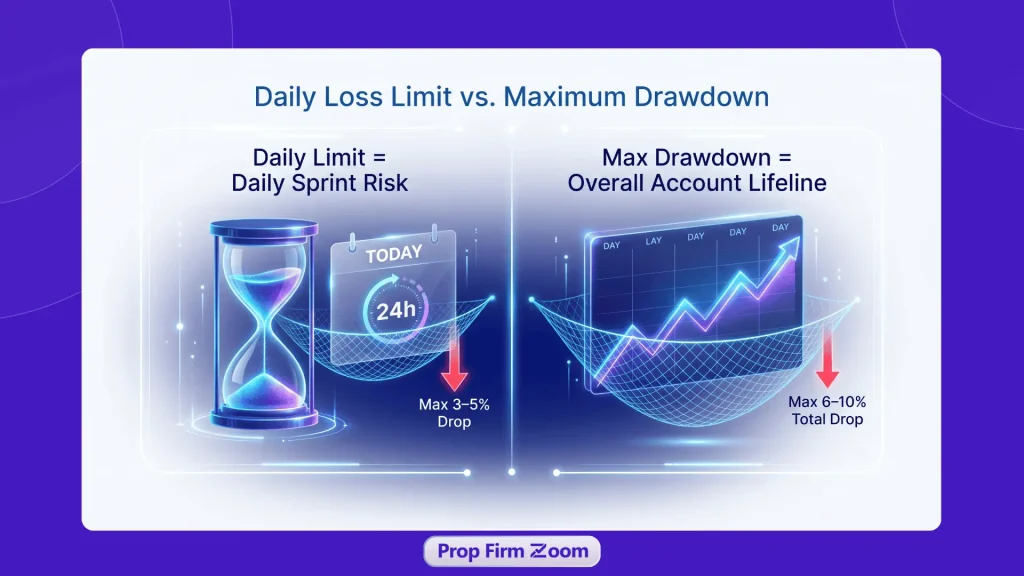
For example, a prop firm could have a 3% daily loss limit and a 6% maximum drawdown. In this case, losing 3% or more in one trading day could violate the daily rule even though the account has not reached its 6% overall drawdown threshold.
What Counts Toward the Daily Loss Limit?
The components included in the daily loss calculation can vary between prop firms. A review should therefore examine whether the limit includes realized losses, unrealized losses, trading fees, commissions, swaps, or other account costs.

Open positions are particularly important because an unrealized loss may count toward the daily limit even if the position has not been closed. Some firms may also calculate the limit using the account’s equity rather than its balance, which can make the rule more restrictive during periods of temporary market volatility.
For this reason, traders should not evaluate a daily loss limit based only on its percentage. The calculation method and the conditions attached to the rule are equally important when reviewing a prop firm.
How to Evaluate Daily Loss Limits in Prop Firm Reviews
When reviewing a prop firm, the daily loss limit should not be judged by its percentage alone. The calculation method, account reference value, reset schedule, and treatment of open positions can significantly change how restrictive the rule is. Traders should evaluate each of these factors together to understand the actual risk conditions attached to an account.

Daily Loss Percentage
The daily loss percentage determines how much an account can lose before the trader violates the firm’s rules. A 5% daily loss limit generally provides more room than a 3% limit, assuming the firms use comparable calculation methods.
However, a higher percentage does not automatically mean a better rule. The daily limit should be considered alongside the maximum drawdown, profit target, and trading strategy. A trader who regularly holds volatile positions may need more daily room than a trader using smaller, shorter term positions.
When comparing prop firms in a review, it is therefore useful to record the exact daily loss percentage and the balance or equity amount it represents.
Static vs. Trailing Daily Loss Limits
The next factor to evaluate is whether the daily loss limit is static or trailing.

A static limit is generally tied to a defined reference point and does not move as the account changes. A trailing limit, by contrast, can adjust as the account reaches new highs or as the firm’s calculation mechanism changes.
This distinction matters because a moving loss threshold can affect how much room a trader has after profitable trades. A prop firm review should clearly explain whether the daily limit remains fixed throughout the trading day or changes according to account performance.
Balance Based vs. Equity Based Calculations
Prop firms can calculate daily losses using the account’s balance or equity, and the difference can materially affect the rule.
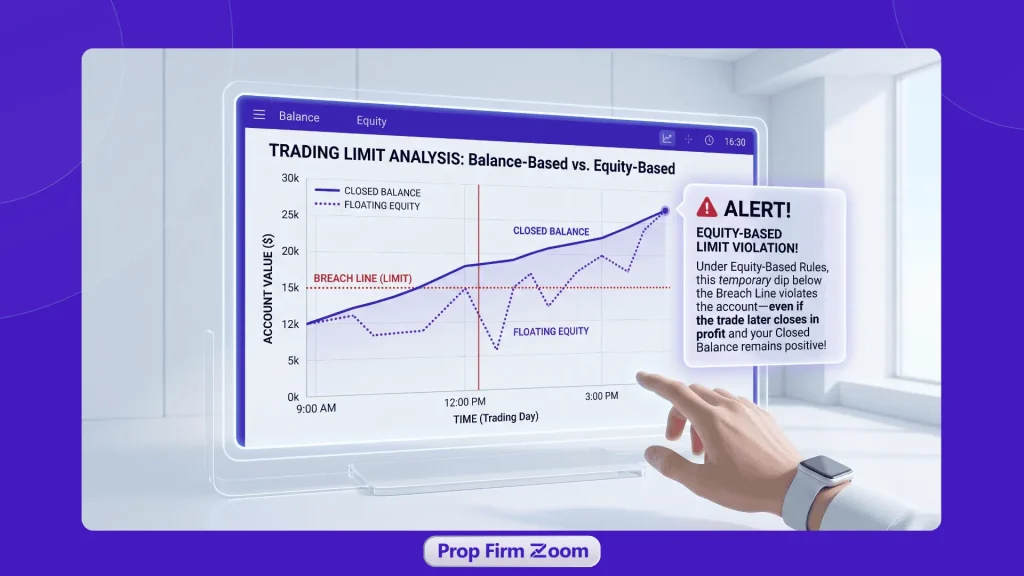
A balance based calculation generally focuses on realized account value, while an equity based calculation can also reflect the profit or loss of open positions. This means a trader with a temporary floating loss could approach or breach the daily limit even without closing the position.
When conducting a prop firm review, traders should check exactly which value the firm uses and whether commissions, fees, and unrealized P&L are included in the calculation.
Reset Time and Trading Day Rules
The daily loss limit only makes sense when the trader knows exactly when the trading day resets. Prop firms may use different reset times or time zones, so the same trade can potentially fall under different trading days depending on the firm’s rules.

A review should therefore identify the exact reset time, applicable time zone, and how trades that remain open across the reset are handled. This is especially important for swing traders and anyone holding positions through major market sessions.
A clearly defined reset schedule makes the rule easier to manage, while an unclear or unusual reset mechanism can create additional risk for traders.
Daily Loss Limit Rules to Check in a Prop Firm
A prop firm’s advertised daily loss percentage does not tell the whole story. The way losses are calculated and the circumstances that can trigger a violation can make the rule more or less restrictive in practice. When conducting a prop firm review, traders should examine how the firm handles open positions, closed trades, daily resets, and breaches before assessing the quality of its risk rules.

Floating Losses and Open Positions
One of the most important details to check is whether floating losses from open positions count toward the daily loss limit. Some prop firms calculate the limit using account equity, meaning unrealized losses can reduce the remaining daily loss allowance even when a position has not been closed.
This can become particularly important during periods of high volatility. A position may temporarily move against the trader and later recover, but the temporary drawdown could still contribute to the daily loss calculation. A prop firm review should therefore state clearly whether unrealized P&L is included and at what point it can trigger a breach.
Losses From Closed Trades
Closed trades are generally part of the daily loss calculation, but the exact rules can differ between firms. Traders should check whether realized trading losses, commissions, fees, or other costs are included when calculating the daily limit.
For example, a trader may stay within the stated percentage based on trade losses alone but exceed the limit once transaction costs are included. When reviewing a prop firm, it is therefore important to look beyond the headline daily loss percentage and understand the firm’s complete calculation method.
Trades Opened Before the Daily Reset
Trades that remain open when the trading day resets can create additional complexity. A review should explain how a prop firm treats positions opened on the previous trading day and whether their unrealized P&L is carried into the new daily loss calculation.
The reset mechanism is especially relevant for traders who hold positions across sessions or overnight. If the firm uses equity based calculations, changes in the value of an open position around the reset can affect the available loss allowance for the new trading day.
Daily Loss Limit Breach Conditions
Finally, traders should determine exactly what constitutes a daily loss limit breach. Some firms may consider the limit breached as soon as account equity reaches the threshold, while others may apply specific conditions related to balance, closed losses, or account activity.
A prop firm review should also clarify whether reaching the limit results in an immediate account violation, whether positions are automatically closed, and whether there are any exceptions or additional requirements. Understanding the breach conditions is essential because a rule that appears flexible on paper can be considerably stricter depending on how violations are enforced.
Comparing Daily Loss Limits in Prop Firm Reviews
Comparing daily loss limits across prop firms requires more than looking at the percentage shown on each account. Two firms can advertise the same daily loss limit while applying very different calculation methods, reset schedules, or equity rules. A meaningful prop firm review should compare these details together to determine how much practical flexibility each rule provides to traders.
Comparing Different Daily Loss Percentages
The daily loss percentage is one of the easiest factors to compare, but it should always be considered in context. For example, a 5% daily loss limit gives a trader more room than a 3% limit when other conditions are the same.
However, the percentage alone does not determine how restrictive a rule is. A lower daily limit may still be manageable if the firm uses a static calculation and allows sufficient room relative to its maximum drawdown. When comparing prop firms, traders should consider the daily percentage alongside the overall drawdown and other account restrictions.
Comparing Static and Trailing Limits
Static and trailing daily loss limits can create very different trading conditions. A static limit provides a fixed reference point, while a trailing mechanism can adjust based on account performance or other predefined conditions.
When reviewing multiple prop firms, traders should determine whether the daily loss threshold moves, what causes it to change, and whether profitable trades increase or alter the available loss buffer. This helps distinguish between firms that offer similar headline percentages but provide different levels of practical risk flexibility.
Comparing Reset Times and Calculation Methods
Reset time and calculation method are two additional factors that can significantly affect a daily loss rule. Firms may use different time zones or reset schedules, while their calculations may be based on balance, equity, realized P&L, or unrealized P&L.

A useful prop firm review should compare these details rather than simply listing each firm’s daily loss percentage. Traders should look at when the limit resets, what account value is used, whether floating losses count, and how open positions are treated. These differences can have a greater practical impact than a small difference in the advertised daily loss percentage.
How Daily Loss Limits Affect a Prop Firm Review
The daily loss limit can have a significant impact on how a prop firm is evaluated because it directly affects the trader’s room to manage losing positions and short term volatility. A review should consider not only whether the limit is strict or flexible, but also how well it fits the firm’s overall risk structure and the types of trading strategies it allows.
Impact on Trading Flexibility
A tighter daily loss limit gives traders less room to absorb short term losses, which can restrict how they manage positions throughout the trading day. A more flexible limit may allow traders to withstand temporary market volatility without immediately approaching a rule violation.
When reviewing a prop firm, the daily loss limit should therefore be considered alongside position sizing, leverage, maximum drawdown, and other trading restrictions. A percentage that looks reasonable in isolation may be more restrictive when combined with several other limits.
Impact on Risk Management
Daily loss limits are designed to prevent traders from accumulating excessive losses in a single trading session. From a prop firm review perspective, the key question is whether the rule creates a reasonable risk boundary without making normal trading activity unnecessarily difficult.
A well defined daily loss limit can encourage disciplined position sizing and help prevent traders from continuing to trade after a series of losses. However, the calculation method and breach conditions matter just as much as the percentage itself. Clear rules make the risk framework easier for traders to understand and manage.
Impact on Different Trading Strategies
The effect of a daily loss limit can vary significantly depending on the trading strategy. Scalpers may take many trades within a short period, making a tight daily limit particularly important. Day traders may also need enough room to handle several consecutive losing trades without immediately violating the account rules.
Swing traders can face a different issue because open positions may experience substantial unrealized losses before recovering. If a prop firm uses equity based calculations, these temporary movements can count toward the daily loss limit.
For this reason, a prop firm review should consider whether the daily loss rule is compatible with the trading styles the firm permits. The same limit can be relatively flexible for one strategy and highly restrictive for another.
How Daily Loss Limits Interact With Other Prop Firm Rules
A daily loss limit should not be evaluated in isolation because its practical impact depends on the other rules attached to a prop firm account. Maximum drawdown, profit targets, leverage, and position sizing can all change how much flexibility a trader actually has. Reviewing these rules together provides a more accurate picture of the account’s overall risk conditions.
Daily Loss Limit and Maximum Drawdown
The daily loss limit and maximum drawdown work together to define how much risk a trader can take over both short and longer periods. A daily loss limit controls losses within a single trading day, while maximum drawdown limits the account’s overall decline.

For example, a prop firm with a 3% daily loss limit and a 6% maximum drawdown gives the trader a relatively small margin between a significant single day loss and the account’s overall drawdown threshold. When reviewing a prop firm, traders should consider whether the daily limit provides reasonable room relative to the maximum drawdown.
Daily Loss Limit and Profit Targets
The relationship between the daily loss limit and profit target can also affect how demanding an account is to trade. A high profit target combined with a tight daily loss limit may require traders to reach their target while operating within relatively limited daily risk.
A prop firm review should therefore consider how much profit a trader needs to generate compared with the amount they can lose each day. This helps provide context for whether the account’s objectives and risk restrictions are reasonably balanced.
Daily Loss Limit and Leverage
Leverage can increase the practical importance of a daily loss limit because larger positions can produce larger gains or losses from relatively small market movements. A trader using high leverage may approach the daily threshold much faster than a trader using smaller exposure.
When reviewing a prop firm, leverage should therefore be considered alongside the daily loss rule. A relatively generous daily limit may still be restrictive if the available leverage encourages or permits large positions that can produce significant intraday losses.
Daily Loss Limit and Position Size
Position size directly affects how quickly a trader can approach the daily loss threshold. Larger positions can consume a greater portion of the daily loss allowance from a single losing trade, while smaller positions generally provide more room for multiple trades.
For this reason, traders should evaluate the daily loss limit together with any position size restrictions, maximum position limits, or exposure rules. The combination of these requirements can have a significant effect on which trading strategies are practical within a prop firm account.
Daily Loss Limit Examples for Prop Firm Reviews
Examples make it easier to understand how a daily loss limit works in practice and why the calculation method matters when reviewing a prop firm. The same advertised percentage can produce different outcomes depending on whether the firm uses balance, equity, or another reference point.
Example of a 3% Daily Loss Limit
Consider a prop firm account with a starting balance of $100,000 and a 3% daily loss limit. If the firm calculates the limit from the daily starting balance, the maximum permitted loss for that day would be $3,000.
If the trader loses $1,200 on one trade and another $1,000 on a second trade, the total loss reaches $2,200, leaving $800 of room before the daily limit is reached. A further $800 loss would bring the account to the 3% threshold.
When reviewing a prop firm, however, this calculation should not be assumed automatically. The review should confirm whether the 3% limit is based on the starting balance, equity, or another reference value.
Example of an Equity Based Daily Loss Limit
Suppose the same $100,000 account has a 3% daily loss limit, but the firm calculates the limit using equity. The trader opens a position and the trade moves $2,000 against them while still remaining open.
Even though the trader has not closed the position, the account equity has fallen by $2,000. If the firm’s rules count unrealized losses, only $1,000 of the daily loss allowance would remain.
This example shows why the calculation method matters in a prop firm review. A daily loss limit that appears generous based on its percentage may provide less practical room when floating losses are included.
Example of a Daily Loss Limit Breach
Consider a $50,000 account with a 4% daily loss limit, giving the trader a $2,000 daily loss allowance under the firm’s stated calculation method.
The trader loses $1,400 across several closed trades and then has another $700 of loss on an open position. If the firm includes unrealized losses in its calculation, the total daily loss reaches $2,100.
The trader has therefore exceeded the $2,000 limit and may have violated the account rules, even though the closed trade losses alone were below the threshold.
This is why a prop firm review should explain what counts toward the daily loss limit and when a breach occurs, rather than relying only on the percentage advertised by the firm.
Daily Loss Limit Review Checklist for Prop Firms
A daily loss limit should be reviewed as part of the prop firm’s overall risk framework, not as an isolated percentage. Before joining a firm, traders should confirm how the limit is calculated, when it resets, what losses count toward it, and what happens when the threshold is reached.

What to Verify Before Joining a Prop Firm
Before accepting a prop firm’s rules, verify these key details:
- Daily loss percentage: What percentage or dollar amount is allowed?
- Calculation method: Is the limit based on balance, equity, or another reference value?
- Static or trailing: Does the loss threshold remain fixed or change over time?
- Floating losses: Do unrealized losses on open positions count?
- Trading costs: Are commissions, fees, or other costs included?
- Reset time: When does the daily loss limit reset, and which time zone applies?
- Open positions: How are positions carried through the daily reset handled?
- Breach conditions: What exactly happens when the limit is reached or exceeded?
- Interaction with maximum drawdown: How does the daily limit work alongside the firm’s overall drawdown rule?
Checking these points gives traders a clearer picture of how restrictive the firm’s risk rules actually are.
Questions to Ask When Reviewing Daily Loss Rules
When conducting a prop firm review, the following questions can help identify important differences between firms:
- What is the exact daily loss limit?
- Is it calculated from balance or equity?
- Are unrealized losses included?
- Do commissions and fees count toward the limit?
- Is the limit static or trailing?
- What time does the trading day reset?
- What happens to open positions at the reset?
- Does reaching the limit immediately violate the account?
- How is the daily limit calculated after profitable trades?
- How does the daily loss limit interact with the maximum drawdown?
These questions make it easier to compare prop firms based on their actual daily risk rules, rather than relying only on the percentage displayed on an account page.
Final Thoughts on Daily Loss Limits in Prop Firm Reviews
Daily loss limits are an important part of evaluating a prop firm because they directly affect how much short term risk a trader can take. A proper prop firm review should look beyond the advertised percentage and examine the calculation method, reset time, treatment of open positions, and breach conditions.
Comparing these details can help traders understand whether a firm’s daily loss rule is practical for their trading style and how it fits with the account’s overall drawdown structure.
FAQ About Daily Loss Limits in Prop Firm Reviews
What is a daily loss limit in a prop firm?
A daily loss limit is the maximum amount a trader can lose within a trading day before violating a prop firm’s account rules. The limit may be calculated using the account balance, equity, or another reference value, depending on the firm.
How is a daily loss limit calculated?
Prop firms can calculate daily losses in different ways. Common methods use a percentage of the account balance or equity and may include realized losses, unrealized losses, commissions, and other trading costs. The firm’s specific rules determine which calculation applies.
What is the difference between daily loss limit and maximum drawdown?
A daily loss limit restricts losses within a single trading day, while maximum drawdown limits the overall decline of an account. A trader can breach the daily loss limit without reaching the maximum drawdown if too much is lost during one trading day.
Do floating losses count toward the daily loss limit?
They can. Some prop firms use equity based calculations, meaning unrealized losses from open positions may count toward the daily loss limit. Traders should check each firm’s rules to determine whether floating P&L is included.
What should traders check when reviewing a prop firm’s daily loss limit?
Traders should check the daily loss percentage, calculation method, static or trailing structure, reset time, treatment of floating losses and open positions, trading costs, and the conditions that trigger a breach. These factors provide a more complete picture than the advertised percentage alone.