Why On Chain Payouts Matter in Prop Firm Reviews
Payouts are one of the most important parts of evaluating a prop firm because a successful trading experience ultimately depends on whether approved profits can be withdrawn reliably. An on chain payout adds another layer of evidence to this process by allowing traders to inspect the blockchain record rather than relying entirely on the firm’s own claims.
This does not mean that an on chain transaction automatically makes a prop firm trustworthy. Instead, it gives reviewers and traders a verifiable source of information that can be used alongside payout policies, trader reports, processing times, and other evidence when assessing a firm.
Verifying That Payouts Actually Occurred
One of the biggest advantages of an on chain payout is that the transaction can be independently verified.
If a prop firm claims that a trader received a $2,000 USDC payout, a transaction ID can potentially confirm that the funds were actually transferred. By opening the transaction in the relevant blockchain explorer, a reviewer can check the sending address, receiving address, amount, network, and transaction status.
This creates an important distinction between a reported payout and a verifiable payout. A company dashboard or payout announcement may state that a withdrawal was completed, but an on chain transaction provides additional evidence that the transfer took place.
However, reviewers should avoid treating a single transaction as proof of a firm’s overall payout reliability. A more meaningful assessment looks at multiple verified transactions and whether they are consistent with the firm’s stated withdrawal process.

Transparency and Transaction Visibility
For a prop firm review, this can provide useful information that would otherwise be difficult to verify, including:
- When a payout was sent
- How much was transferred
- Which blockchain was used
- Which wallet sent the funds
- Which wallet received the funds
- Whether the transaction was confirmed
This visibility can be particularly useful when a prop firm publishes payout records or transaction IDs. Instead of simply accepting a claim that traders have been paid, reviewers can inspect the underlying blockchain activity.
At the same time, blockchain transparency has limits. A visible transaction does not reveal the firm’s internal approval process, the reason another trader’s withdrawal may have been rejected, or whether the company will maintain the same payout practices in the future.
Payout Speed and Processing Times
On chain transactions can also help distinguish between different stages of the withdrawal process.
A trader may submit a payout request on Monday, receive approval several hours later, and then wait for the blockchain transaction to be broadcast and confirmed. These are separate stages, even though a prop firm’s dashboard may simply display the payout as “processing.”

For example:
Payout Request → Internal Review → Payout Approval → Blockchain Transfer → Network Confirmation → Funds Received
A blockchain explorer can help establish when the actual transaction was submitted and confirmed. However, it cannot show how long the prop firm’s internal review took before the transaction was created.
This distinction is important when comparing payout performance. A fast blockchain confirmation does not necessarily mean the prop firm processes withdrawals quickly. The network may settle the transaction within minutes while the firm’s internal approval process takes several hours or days.
Understanding the Difference Between Processing and Settlement
Processing time refers to how long the prop firm takes to review and execute a payout request. Settlement time refers to how long it takes for the blockchain transaction to be processed and confirmed after the payment has been sent.
For example, imagine a trader requests a payout at 10:00 AM:
- 10:00 AM: Payout request submitted
- 2:00 PM: Prop firm approves the request
- 2:15 PM: Transaction is broadcast to the blockchain
- 2:17 PM: Transaction is confirmed
- 2:18 PM: Trader receives the funds
In this example, the prop firm’s processing time is about four hours, while the on chain settlement takes only a few minutes.
This is why a good prop firm review should not simply state that a payout was “fast.” It should distinguish between the firm’s internal processing time and the blockchain’s settlement time. On chain data is especially useful for verifying the second part of that equation.
What Is an On Chain Payout?
An on chain payout is a payment that is transferred directly through a blockchain network and recorded on a public ledger. In the context of prop trading, it usually refers to a prop firm sending a trader’s approved profit payout in cryptocurrency from one wallet to another. Because the transaction is recorded on the blockchain, the payment can potentially be verified independently rather than relying only on a company’s internal records or payment confirmation.

For example, suppose a trader requests a $2,000 USDC payout from a prop firm. If the firm sends the payment on the Ethereum network, the transaction creates a permanent blockchain record. The trader can use the transaction ID (TxID) to open a blockchain explorer and check whether the transaction was confirmed, which wallet sent the funds, which wallet received them, and how much was transferred.
This is different from simply receiving an email that says a payout has been processed. An email or dashboard status is a statement from the company, while an on chain transaction provides an independently accessible record of the transfer itself.
How an On Chain Payout Works
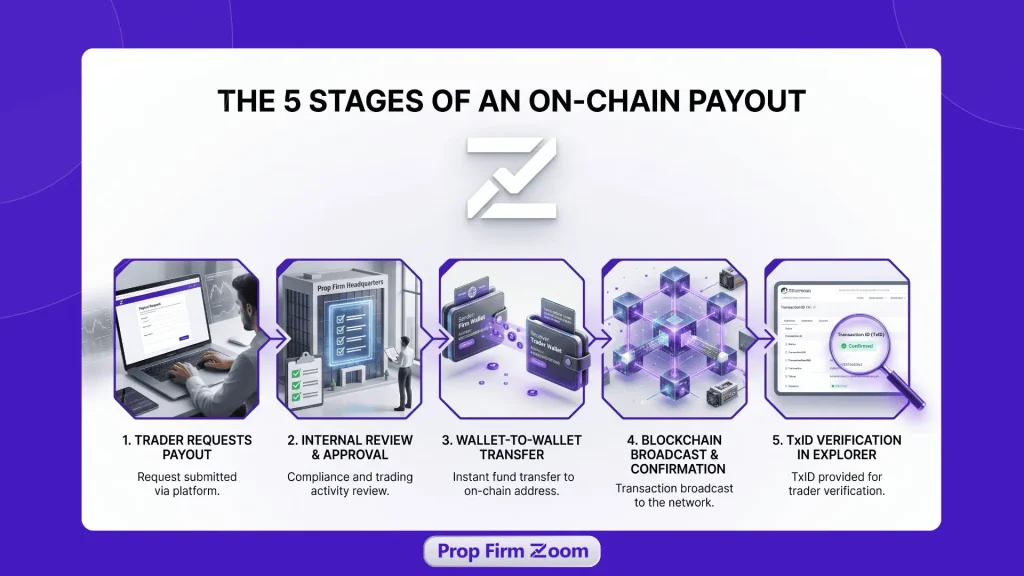
The process typically involves several steps:
- Payout request: The trader becomes eligible for a withdrawal and submits a payout request.
- Payout approval: The prop firm reviews the request according to its withdrawal rules.
- Wallet transfer: The firm sends the approved amount from its payout or treasury wallet to the trader’s wallet.
- Blockchain confirmation: The transaction is processed and recorded on the selected blockchain network.
- Transaction verification: The trader can use the TxID to verify the transaction through a blockchain explorer.
For example, a payout sent as USDC on Ethereum or Arbitrum will have a transaction record that can be inspected on the relevant blockchain explorer. The exact process can vary between prop firms depending on the assets, networks, and payout systems they support.

What Can You Verify From an On Chain Payout?
An on chain transaction can provide useful information for reviewing a prop firm’s payment history, including:
- Transaction status: Whether the transaction was confirmed or failed
- Payout amount: The amount of cryptocurrency transferred
- Sending wallet: The address from which the funds were sent
- Receiving wallet: The trader’s destination address
- Network: The blockchain used to process the payment
- Transaction time: When the transfer was submitted and confirmed
- Transaction ID: The unique identifier used to locate the payment on chain
However, there is an important limitation: an on chain transaction proves that a specific transfer occurred, not that the entire payout system is reliable. A blockchain record cannot independently confirm why a payout was approved or rejected, whether a trader met all withdrawal conditions, or whether the company will process future requests in the same way.
How On Chain Payouts Work at Prop Firms
An on chain prop firm payout typically follows a straightforward process: a trader requests a withdrawal, the prop firm approves the payout, and the funds are transferred from a company controlled wallet to the trader’s crypto wallet. Once the transaction is broadcast to the blockchain, the transfer receives a transaction ID and can be independently checked on a blockchain explorer.
For example, if a trader is approved for a $3,000 USDC payout, the prop firm may send the USDC from its treasury or payout wallet to the trader’s designated wallet. The exact process varies between firms, but the blockchain transaction creates a public record of the transfer that can later be used to verify the payment.
From Prop Firm Treasury to Trader Wallet
The first part of an on chain payout is the movement of funds from a wallet controlled by the prop firm to the trader’s wallet. Depending on the company’s internal structure, the sending address may be described as a treasury wallet, payout wallet, or company wallet.
A simplified payout flow looks like this:
Prop Firm → Payout/Treasury Wallet → Blockchain Network → Trader Wallet
In some cases, the prop firm may send the payout directly from its treasury wallet. In others, it may use a separate wallet dedicated to processing trader withdrawals. This distinction matters when reviewing payout records because the sending address should be identifiable and consistently associated with the company’s payment activity where possible.
For example, if a prop firm sends 2,000 USDC on Arbitrum to a trader, the trader can check the transaction on an Arbitrum blockchain explorer to confirm that the funds left the sending wallet and arrived at the intended destination.
The blockchain does not necessarily tell you why the payment was made or whether the trader satisfied the firm’s internal withdrawal requirements. It verifies the transfer itself.
Blockchain Transactions and TxIDs
Every confirmed blockchain transaction has a unique identifier, commonly called a transaction ID (TxID) or transaction hash. This identifier acts as a reference for locating the payment on the blockchain.

A trader can enter the TxID into the appropriate blockchain explorer and typically see information such as:
- Sending wallet address
- Receiving wallet address
- Amount transferred
- Cryptocurrency or token
- Blockchain network
- Transaction status
- Block confirmation
- Transaction timestamp
- Network fee
For example, a payout confirmation might provide a TxID that allows the trader to independently verify that 1,500 USDC was transferred from the prop firm’s wallet to the trader’s wallet. This is more verifiable than relying solely on a dashboard showing “Payout Completed.”
However, a TxID should not be treated as proof of everything surrounding a payout. It confirms a blockchain transaction, but it does not independently establish the prop firm’s overall financial health, withdrawal policy, or reliability.
Stablecoins and Crypto Payouts
Many crypto focused prop firms use stablecoins for payouts because their value is designed to remain relatively stable compared with cryptocurrencies such as Bitcoin or Ethereum.
USDC and USDT are common examples. A prop firm might offer payouts in a stablecoin while allowing traders to select a particular blockchain network supported by the company.
The choice of network can affect the payout experience. Different networks may have different transaction fees, confirmation times, wallet compatibility, and availability across exchanges and wallets.
For this reason, a proper payout review should consider more than simply whether a prop firm supports crypto withdrawals. It should also examine which assets and networks are supported, how transactions are verified, and whether the stated payout process matches the actual on chain records.
What to Check When Reviewing a Prop Firm’s On Chain Payouts
Not every crypto payout system provides the same level of transparency. When reviewing a prop firm’s on chain payouts, traders should look beyond whether the company supports cryptocurrency withdrawals and examine the details of how those payments are actually processed and verified.

A useful review should consider the blockchain networks, payout assets, withdrawal conditions, wallet addresses, transaction records, and payment frequency. Together, these factors can provide a clearer picture of how transparent and verifiable a prop firm’s payout system is.
Supported Blockchain Networks
The blockchain network used for a payout affects transaction speed, fees, wallet compatibility, and the overall withdrawal experience. A prop firm may support one network for a particular asset or offer several options.
For example, USDC may be available on networks such as Ethereum, Arbitrum, or another supported chain. Sending the asset on the wrong network can create complications or even result in funds becoming inaccessible.
When reviewing a prop firm’s payout system, check:
- Which blockchain networks are supported
- Which networks are available for each payout asset
- Whether the network is clearly specified before withdrawal
- Whether the supported network matches the transaction records
- Whether network fees or other charges apply
A broader selection of networks is not necessarily better. What matters is whether the available options are clearly documented and consistently used.
Supported Payout Assets
The asset used for withdrawals is another important part of an on chain payout review.
Many crypto prop firms use stablecoins such as USDC or USDT because they reduce the price volatility that would come with paying traders in assets such as BTC or ETH. However, the exact assets available can differ between firms.
Reviewers should check:
- Which cryptocurrencies or stablecoins can be used for payouts
- Whether the payout asset is fixed or selectable
- Whether the payout currency differs from the account’s displayed currency
- Whether conversion fees or additional charges apply
- Whether the supported asset matches the asset shown in the blockchain transaction
For example, if a firm states that payouts are made in USDC, a verified transaction should show the corresponding token rather than simply a dollar denominated value on the firm’s dashboard.
Payout Frequency and Eligibility
An on chain transaction only tells you that a payment was made. It does not tell you when a trader becomes eligible to request that payment.
This is why payout frequency and eligibility rules should be reviewed separately from blockchain settlement.
Important questions include:
- How often can traders request withdrawals?
- Is there a minimum number of trading days?
- Is there a minimum payout amount?
- Are there consistency or profit requirements?
- Are there additional conditions before a withdrawal is approved?
- Does the firm impose limits on payout frequency?
For example, a prop firm might process blockchain transactions quickly but only allow traders to request payouts once every five trading days. In that case, fast on chain settlement should not be confused with frequent payout availability.
Wallet to Wallet Payment Verification
One of the most useful aspects of an on chain payout is the ability to verify the movement of funds between wallets.
A reviewer can compare the sending wallet shown in the blockchain transaction with the wallet address associated with the prop firm’s payout activity and then verify that the receiving address belongs to the intended trader.
For example:
Prop Firm Wallet → Trader Wallet
If the transaction shows the expected amount, asset, network, and destination address, it provides evidence that the stated payout was actually transferred.
However, wallet attribution requires caution. A blockchain address does not automatically identify its owner. Unless a wallet has been publicly identified by the prop firm or can otherwise be reliably attributed, reviewers should avoid claiming that an address definitively belongs to the company.
Transaction IDs and Blockchain Explorers
A transaction ID (TxID) is one of the most useful pieces of evidence when reviewing an on chain payout. It provides a direct way to locate a specific payment on the blockchain.
Using the TxID, a reviewer can open the relevant blockchain explorer and verify:
- Transaction status
- Sending and receiving addresses
- Amount transferred
- Token or cryptocurrency
- Blockchain network
- Block confirmation
- Transaction timestamp
- Network fee, where applicable
For example, if a prop firm provides a TxID for a 2,000 USDC payout on Arbitrum, the reviewer can use the appropriate explorer to check whether that transaction exists and whether the recorded details match the firm’s payout information.

This makes TxIDs particularly valuable in a prop firm review, because they allow at least part of the payout claim to be checked independently rather than relying solely on screenshots, dashboard data, or company statements.
The strongest approach is to treat blockchain records as one source of evidence within the review, alongside the firm’s published payout rules, processing times, trader experiences, and other verifiable information.
How to Verify a Prop Firm Payout On Chain
One of the main advantages of an on chain payout is that traders do not have to rely entirely on a prop firm’s internal dashboard or payout announcements. If a transaction ID is available, the payment can be checked directly on the blockchain.
The verification process is relatively straightforward. A trader or reviewer can follow the transaction from its identifier to the blockchain record and compare the on chain information with the payout details provided by the prop firm.
Find the Transaction ID
The first step is to obtain the transaction ID (TxID), also known as the transaction hash. This is the unique identifier assigned to a blockchain transaction.
A prop firm may provide the TxID through:
- A payout confirmation
- The trader dashboard
- An email notification
- A support response
- A publicly available payout record
For example, if a trader receives a notification stating that a 1,500 USDC payout has been sent, the notification may include a transaction hash. That hash can then be used to locate the payment on the relevant blockchain.
If no TxID is provided, verification may still be possible using wallet addresses and transaction details, but identifying the correct payment becomes more difficult.
Check the Blockchain Explorer
Once the TxID is available, the next step is to open the blockchain explorer corresponding to the network used for the transaction.
For example, a transaction sent on Ethereum should be checked using an Ethereum compatible explorer, while a transaction sent on Arbitrum should be checked on an explorer that indexes the Arbitrum network.
A blockchain explorer typically displays information such as:
- Transaction status
- Block number and confirmations
- Sender and recipient addresses
- Token transferred
- Transaction amount
- Transaction timestamp
- Network fee
The key point is to make sure the explorer matches the actual network used for the payout. Searching for an Ethereum transaction on the wrong network, for example, will not produce the expected result.
Verify the Sending and Receiving Wallets
After locating the transaction, compare the wallet addresses with the payout information provided by the prop firm and trader.
The sending address should correspond to the wallet from which the payout was made, while the receiving address should match the trader’s designated wallet.
For example:
Sending Wallet → 2,000 USDC → Trader Wallet
If the addresses, asset, and transaction details match the payout information, the blockchain record provides evidence that the funds were transferred.
There is an important limitation, however. A blockchain address does not automatically reveal who controls it. Reviewers should only identify a wallet as belonging to a prop firm when there is sufficient evidence, such as an official disclosure or a consistent and verifiable association with the firm’s payout activity.
Confirm the Amount and Transaction Status
The final step is to compare the blockchain transaction with the payout that was reported by the prop firm.
Check that:
- The asset matches the stated payout currency.
- The amount matches the approved withdrawal, accounting for any clearly disclosed fees.
- The receiving wallet is correct.
- The transaction status shows successful confirmation.
- The timestamp is consistent with the stated payout processing time.
- The network matches the one specified by the prop firm.
For example, if a prop firm reports a $2,000 USDC payout, the on chain record should allow the reviewer to determine whether the stated amount was actually transferred and whether the transaction was successfully confirmed.
This creates a simple verification chain:
Payout Claim → TxID → Blockchain Explorer → Wallets → Amount → Transaction Status
For a prop firm review, this process provides stronger evidence than relying on a payout screenshot alone. It does not prove every aspect of the firm’s withdrawal practices, but it can independently verify whether a particular on chain payment actually occurred.
On Chain Payouts vs Traditional Prop Firm Payouts
Prop firms can use several different methods to pay traders, and the payment method affects how easily a payout can be verified. Bank transfers and payment processors typically rely on private financial systems, while on chain crypto payouts create a publicly accessible transaction record.
This does not mean that on chain payouts are automatically faster, safer, or better. Each method has different advantages and limitations, particularly when the goal is to review and verify a prop firm’s payout history.
Bank Transfers
Bank transfers are a traditional way for businesses to send funds to individuals. A prop firm may use a bank or financial institution to transfer a trader’s approved payout directly to their bank account.
The main limitation from a review perspective is limited public visibility. The transaction details are generally accessible only to the parties involved and the financial institutions processing the payment.
A reviewer may be able to confirm that a trader received a payout through a bank statement or payment confirmation, but there is no publicly searchable ledger comparable to a blockchain explorer.
Bank transfers can still provide useful evidence of successful payouts, but they are more difficult for an independent reviewer to verify because the underlying transaction is private.
Payment Processors
Some prop firms use third party payment processors to handle trader withdrawals. In this model, the prop firm sends the payout through an external payment service, which then facilitates the transfer to the trader.
This can make the payment process more convenient for traders, but it introduces another layer between the prop firm and the recipient.
For example:
Prop Firm → Payment Processor → Trader
The trader may receive a confirmation showing that the payment was processed, but the underlying movement of funds may not be publicly visible. A reviewer therefore has to rely more heavily on the firm’s records, the processor’s confirmation, or the trader’s own evidence.
Payment processors can also have their own processing times, fees, eligibility requirements, and geographic restrictions, which should be considered when assessing a prop firm’s withdrawal process.
Crypto Payouts Without On Chain Verification
A payout being made in cryptocurrency does not automatically make it an on chain verifiable payout.
For example, a prop firm might advertise crypto withdrawals but provide only a dashboard status such as “Paid” or “Completed” without providing a transaction ID. The trader may receive the funds, but an independent reviewer has limited ability to verify the transaction directly.
This creates an important distinction:
| Payout Method | Public Transaction Record | Independent Verification |
| Bank transfer | No | Limited |
| Payment processor | Usually no | Limited |
| Crypto payout without TxID | Potentially, but difficult to identify | Limited |
| On chain payout with TxID | Yes | Stronger |
The key difference is not simply fiat vs. crypto. It is whether the payment creates a verifiable transaction record that can be independently matched to the reported payout.
For this reason, when conducting a prop firm review, an on chain payout with a verifiable TxID can provide stronger evidence of an individual payment than a payout confirmation that cannot be independently checked.
Are On Chain Payouts More Transparent?
On chain payouts can provide a higher level of transaction level transparency because blockchain records can be inspected independently after a transaction is confirmed. A reviewer does not have to rely exclusively on screenshots, dashboard updates, or statements from a prop firm to establish that a particular transfer took place.
However, transparency should not be confused with proof of reliability. A blockchain can show what happened to funds in a specific transaction, but it cannot explain everything that happened before or after that transaction. For a meaningful prop firm review, on chain data should therefore be treated as one piece of evidence rather than a complete measure of trustworthiness.
What Blockchain Data Can Prove
A confirmed blockchain transaction can provide objective information about a specific transfer.
Depending on the network and token, a reviewer can typically verify:
- The sending wallet address
- The receiving wallet address
- The amount transferred
- The asset or token
- The blockchain network
- The transaction timestamp
- The transaction status
- The transaction ID
- The applicable network fee
For example, if a prop firm reports that it sent a trader 2,500 USDC, an on chain transaction can be used to check whether that amount was actually transferred to the specified wallet.
This makes blockchain records particularly useful when reviewing individual payout claims. Instead of asking only whether a company says it paid a trader, a reviewer can check whether a corresponding transaction exists.
What Blockchain Data Cannot Prove
Blockchain data has important limitations. A transaction record shows that funds moved between addresses, but it does not provide the full context behind the payment.
For example, a blockchain transaction cannot independently prove:
- Why the payout was approved
- Whether the trader satisfied all withdrawal requirements
- Why another trader’s payout was rejected
- Whether the prop firm’s internal accounting is accurate
- Whether the company has sufficient funds to continue paying traders
- Whether future payouts will be processed in the same way
- Whether a particular wallet is actually controlled by the company without additional evidence
Consider a prop firm that publishes ten successful on chain payouts. Those transactions can verify that ten transfers occurred, but they cannot establish how many traders requested withdrawals during the same period or how many requests were rejected.
That distinction is essential when interpreting blockchain evidence.
Why Transaction Transparency Does Not Guarantee a Prop Firm’s Reliability
A transparent payment record is a positive factor, but it is only one part of evaluating a prop firm.
A company could have a completely verifiable on chain payout history while still having issues with other aspects of its business, such as restrictive withdrawal conditions, unclear rules, poor customer support, or inconsistent account management.
Conversely, a prop firm that uses bank transfers may have limited public transaction visibility without necessarily being unreliable.
The most useful approach is therefore to separate payment transparency from overall reliability.
When conducting a prop firm review, on chain evidence can help answer questions such as:
Did this payout actually occur?
But other sources of evidence are needed to answer broader questions such as:
Does this firm process withdrawals consistently and fairly?
That distinction prevents reviewers from treating blockchain visibility as a guarantee of trust and keeps the analysis focused on what the available evidence can actually demonstrate.
Common On Chain Payout Issues to Consider in Prop Firm Reviews
On chain payouts provide useful transparency, but they are not completely free from problems. A blockchain transaction can be visible and verifiable while the overall payout experience is still affected by network fees, incorrect wallet details, processing delays, or the prop firm’s withdrawal rules.
When conducting a prop firm review, it is therefore important to evaluate not only whether payouts are recorded on chain, but also how reliably and conveniently traders can access those funds.
Network Fees
Blockchain transactions can involve network fees, sometimes called gas fees. These costs are paid to the network for processing and confirming a transaction and can vary depending on the blockchain and network activity.
For example, a payout sent through one network may cost considerably more than the same stablecoin transfer sent through another network. The fee structure can therefore affect the amount a trader ultimately receives if the prop firm passes network costs on to the trader.
A review should clarify:
- Whether the prop firm covers network fees
- Whether fees are deducted from the payout
- Which networks are available
- Whether any additional withdrawal fees apply
The existence of a network fee is not necessarily a problem. What matters is whether the fee is clearly disclosed before the trader requests the payout.
Wrong Network or Wallet Address
Crypto transactions require the correct wallet address and, where applicable, the correct blockchain network. Sending an asset through an unsupported network or entering an incorrect address can create serious problems.
For example, a trader expecting USDC on Arbitrum may provide an address or network configuration that does not match the prop firm’s supported withdrawal method. Depending on the asset, network, and receiving wallet, recovering the funds may be difficult or impossible.
A well designed payout process should therefore clearly communicate:
- The supported network
- The supported asset
- The required wallet format
- Whether the trader can change the withdrawal address
- Whether the company provides any address verification before sending funds
This is also something reviewers should consider when assessing whether a firm’s payout instructions are sufficiently clear.
Delayed Transactions
An on chain payout can be delayed at different stages of the process, and not every delay is caused by the blockchain itself.
There are generally two separate possibilities:
Prop firm processing delay: The company has not yet approved or initiated the payout.
Blockchain confirmation delay: The company has already submitted the transaction, but the network has not yet confirmed it.
For example, a prop firm might approve a payout within a few hours but take several more hours before broadcasting the transaction. Alternatively, the transaction could be submitted immediately but experience slower confirmation because of network conditions.
This distinction is important when reviewing payout speed. A blockchain explorer can help determine when the transaction was actually submitted, but it cannot show how long the prop firm’s internal approval process took.
Failed or Reversed Payments
Blockchain transactions generally cannot simply be reversed once they have been confirmed. This makes it important to distinguish between a failed transaction, an unconfirmed transaction, and a payment that is later corrected through a separate transaction.
A failed blockchain transaction may occur because of insufficient network fees, an invalid transaction, or another network specific issue. In such cases, the original transfer may not have reached the trader even though a transaction attempt exists.
If a payout appears to have failed, a reviewer should check the transaction status rather than assuming that the existence of a TxID means the payment was successful.
It is also useful to determine how the prop firm handles failed payments. Does it automatically retry the transaction? Does it contact the trader? Are additional fees charged? These operational details can significantly affect the actual payout experience.
Payout Restrictions and Eligibility Rules
Not every payout issue is caused by blockchain technology. In many cases, the main restriction comes from the prop firm’s own withdrawal policy.
A firm may require traders to meet conditions such as:
- A minimum number of trading days
- A minimum profit threshold
- A minimum withdrawal amount
- Specific risk or consistency requirements
- A defined payout schedule
- Compliance with account rules before withdrawal
For example, a trader may have a $5,000 profit on their account but still be unable to request the full amount because the firm’s payout rules impose a minimum trading period or withdrawal limit.
This is why on chain payout transparency should be evaluated alongside payout eligibility. A blockchain can verify that an approved withdrawal was transferred, but it cannot determine whether the firm’s withdrawal conditions are reasonable or consistently applied.
For a complete prop firm review, both sides matter: how transparently the firm pays approved withdrawals and how accessible those withdrawals are under its rules.
How On Chain Payouts Affect Prop Firm Reviews
On chain payouts can add a valuable layer of evidence to a prop firm review by making individual payment transactions easier to verify. Instead of relying only on a firm’s payout claims, screenshots, or trader testimonials, reviewers can sometimes examine blockchain records and confirm whether specific payments were actually transferred.

This is particularly useful when assessing payout transparency. A prop firm that provides transaction IDs, clearly identifies its supported networks, and makes payout activity easy to verify gives reviewers more concrete information to work with. However, the presence of on chain payouts should be treated as a review factor, not as a standalone measure of whether a prop firm is trustworthy.
Using On Chain Evidence in a Prop Firm Review
A strong review can use blockchain data to validate specific claims made by a prop firm or its traders.
For example, if a company states that a trader received a $3,000 USDC payout, a reviewer can look for the corresponding transaction and compare:
- The transaction date
- The payout amount
- The cryptocurrency or stablecoin used
- The blockchain network
- The sending wallet
- The receiving wallet
- The transaction status
When these details align with the reported payout, the transaction provides stronger evidence than an unverified screenshot or a simple “paid” status in a trading dashboard.
However, reviewers should avoid extrapolating too much from individual transactions. One verified payout does not establish a consistent payout history. A broader sample of transactions and other sources of evidence provide a more useful basis for evaluating a prop firm’s withdrawal practices.
What On Chain Payouts Add to a Review
On chain payment records can strengthen several parts of a review:
Transparency: Transaction data can be independently inspected.
Verifiability: Specific payout claims can be checked against blockchain records.
Timing: Blockchain timestamps can help establish when a transaction was actually sent and confirmed.
Payment history: Multiple transactions can provide evidence of repeated payout activity.
Accountability: Public transaction records make it harder to dispute whether a particular blockchain transfer occurred.
These benefits are especially relevant for crypto prop firms, where traders may receive payouts directly in stablecoins or other digital assets.
What On Chain Payouts Do Not Replace
Blockchain evidence should complement, rather than replace, the other components of a prop firm review.
A comprehensive review should still examine:
- Payout rules and eligibility requirements
- Profit split and withdrawal limits
- Processing times
- Trading rules
- Maximum and daily drawdown limits
- Customer support
- Account conditions
- Trader experiences and reported issues
- The firm’s overall operating history
For example, a prop firm could have numerous verifiable USDC transactions but still impose restrictive withdrawal conditions. Conversely, a firm that uses traditional payment methods may have less publicly visible payment data without necessarily having poor payout practices.
The most useful conclusion is therefore not that on chain payouts make a prop firm trustworthy, but that they give reviewers an additional source of verifiable evidence.
A Practical Framework for Reviewing On Chain Payouts
When incorporating on chain payouts into a prop firm review, reviewers can evaluate the payment system across four areas:
| Review Factor | What to Check |
| Verifiability | Are TxIDs or other transaction records available? |
| Transparency | Can the sending wallet, receiving wallet, amount, and network be verified? |
| Consistency | Are multiple payouts processed according to the firm’s stated policy? |
| Accessibility | Are payout requirements, fees, timing, and supported networks clearly disclosed? |
This approach keeps the review evidence based. Rather than treating blockchain visibility as a badge of trust, it uses on chain data to answer specific questions about how a prop firm handles withdrawals.
Ultimately, on chain payouts can make the payout portion of a prop firm review more measurable and independently verifiable, but they are only one component of a broader evaluation.
On Chain Payout Checklist for Prop Firm Reviews
When reviewing a prop firm’s payout system, an on chain checklist can help separate verifiable payment evidence from general claims about withdrawals. The goal is not simply to determine whether a firm supports crypto payouts, but to assess how transparent, traceable, and clearly documented the entire process is.
Use the following checklist when evaluating on chain payouts:
| Review Factor | What to Check |
| Supported Networks | Which blockchain networks are available for payouts? |
| Payout Assets | Which cryptocurrencies or stablecoins can traders receive? |
| Payout Frequency | How often can eligible traders request withdrawals? |
| Eligibility Rules | What conditions must be met before requesting a payout? |
| Processing Time | How long does the prop firm take to approve and send the payout? |
| Transaction ID | Does the firm provide a TxID that can be independently verified? |
| Wallet Addresses | Can the sending and receiving addresses be identified and matched? |
| Transaction Status | Does the blockchain record show a successful and confirmed transaction? |
| Payout Amount | Does the on chain amount match the reported payout, accounting for disclosed fees? |
| Network Fees | Who pays the blockchain or withdrawal fees? |
| Payment History | Are multiple payouts available for verification rather than just isolated examples? |
| Payout Restrictions | Are withdrawal limits, schedules, and other conditions clearly disclosed? |
How to Use the Checklist
A single verified transaction should not be treated as proof of a prop firm’s overall payout reliability. Instead, reviewers should look for consistent evidence across multiple transactions and compare that evidence with the firm’s published payout policy.
For example, if a prop firm claims to process USDC payouts every five trading days, a thorough review can examine whether verified transactions appear consistently around the stated schedule and whether the amounts and networks match the firm’s published information.
The checklist can also help identify gaps in transparency. If a firm claims to offer crypto payouts but does not provide transaction IDs, clearly identify supported networks, or explain its withdrawal conditions, there may be less independent evidence available to verify its payout process.
Ultimately, the strongest prop firm reviews combine on chain transaction data with the firm’s rules, payout terms, processing times, and broader trader experience. On chain verification is not a guarantee of reliability, but it can provide valuable evidence when assessing how a prop firm handles withdrawals.
Frequently Asked Questions About On Chain Payouts
What Is an On Chain Payout in a Prop Firm?
An on chain payout is a withdrawal sent by a prop firm through a blockchain network, typically using a cryptocurrency or stablecoin. The transaction is recorded on the blockchain, allowing the payment to be independently verified using a transaction ID (TxID) and a blockchain explorer.
How Can I Verify a Prop Firm Payout on the Blockchain?
To verify a payout, obtain the transaction ID from the prop firm or trader, open the blockchain explorer for the relevant network, and check the transaction details. You can typically verify the sending and receiving wallets, asset, amount, transaction status, and timestamp.
Are On Chain Payouts Safer Than Bank Transfers?
Not necessarily. On chain payouts offer greater transaction visibility because blockchain records can be independently inspected, while bank transfers are generally private. However, transparency does not automatically mean greater overall safety. The security and reliability of a payout also depend on the prop firm’s policies, wallet practices, and withdrawal procedures.
Can a Prop Firm Payout Be Traced on the Blockchain?
Yes, if the payout was made through a public blockchain and the transaction can be identified. A TxID, wallet address, or other transaction details can be used to locate the payment on a blockchain explorer. However, tracing a transaction does not always reveal who controls a particular wallet unless there is reliable evidence linking the address to the prop firm or trader.
What Is a TxID and Why Does It Matter for Payout Verification?
A TxID, or transaction ID, is a unique identifier assigned to a blockchain transaction. It allows traders and reviewers to locate a specific payment and verify details such as the amount, wallet addresses, network, timestamp, and transaction status. This makes TxIDs useful evidence when reviewing a prop firm’s payout claims.
Do On Chain Payouts Guarantee That a Prop Firm Is Reliable?
No. An on chain payout can verify that a specific transaction occurred, but it cannot prove that a prop firm will consistently approve and process future withdrawals. A complete review should also consider payout rules, eligibility requirements, processing times, trading conditions, customer support, and the firm’s broader operating history.