Post Trade Analysis Matters in a Prop Firm Review
A prop firm review should not focus only on account size, profit targets, drawdown limits, or payout terms. These factors explain what a prop firm offers, but they do not always show how its rules affect a trader in practice. Post trade analysis adds another layer by examining actual trading decisions, risk management, execution, and results under the firm’s conditions.
For prop traders, reviewing trades after they are closed can help connect the firm’s stated rules with the practical experience of trading under those rules. It can also reveal whether poor results come from the trading strategy itself, weak execution, or difficulty adapting to specific prop firm requirements.
Reviewing Your Trading Performance
Post trade analysis starts with reviewing your own trading performance. Instead of looking only at whether a trade was profitable, traders should examine why the position was opened, how much risk was taken, whether the entry and exit followed the original plan, and how the position was managed while it was open.
Looking at several trades together is more useful than judging a single winning or losing position. A losing trade can still be a well executed trade if it followed the strategy and respected the planned risk. On the other hand, a profitable trade may have resulted from excessive risk or an impulsive decision.
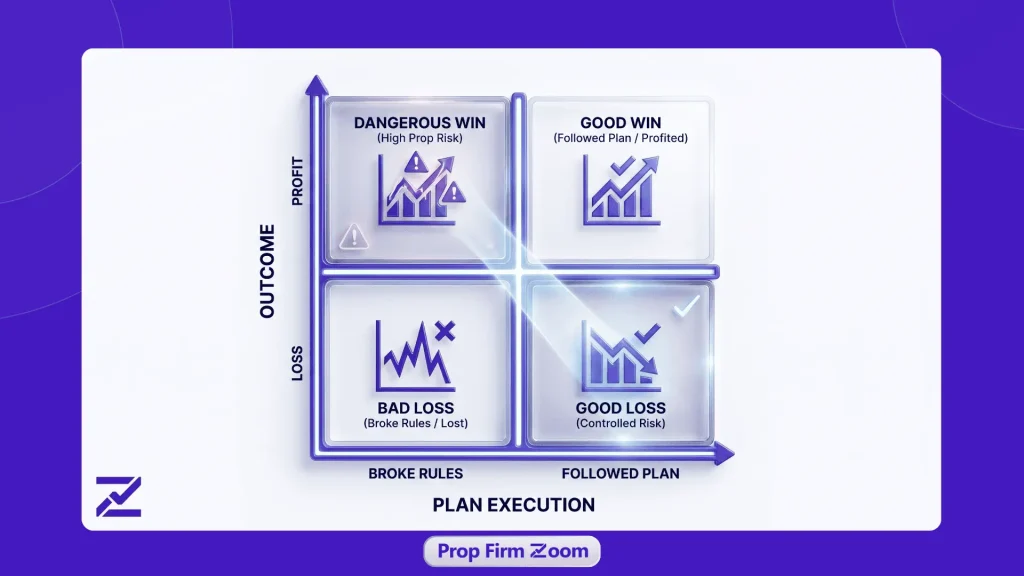
For traders completing a prop firm evaluation, this distinction is especially important. A trader may reach the profit target while taking more risk than the account rules can comfortably support. Post trade analysis can reveal whether profitable results are coming from a consistent process or from taking risks that could eventually lead to a daily loss or maximum drawdown violation.
Reviewing Prop Firm Rules and Trading Conditions
A prop firm review typically explains the firm’s rules and trading conditions, but traders also need to understand how those conditions interact with their own trading style.
Post trade analysis provides a practical way to examine this relationship. Rules involving daily loss limits, maximum drawdown, leverage, position size, holding periods, news trading, or minimum trading days can affect how a strategy is executed. A strategy that works under one set of conditions may become significantly more difficult to manage when those conditions change.
For example, a trader who normally uses large positions may find that a strict drawdown limit leaves little room for a normal losing streak. Similarly, a short term strategy may be affected by execution conditions or restrictions around certain market events.
This makes trade data valuable when reviewing a prop firm. Instead of simply asking whether a particular rule exists, traders can examine how that rule affected their actual trading decisions and results. Over time, this can show whether the firm’s conditions are compatible with the trader’s strategy and risk tolerance.
Connecting Trade Results With Prop Firm Requirements
The final step is connecting individual trade results with the requirements of the prop firm. A trader may have a profitable strategy but still struggle with an evaluation because the strategy creates large short term drawdowns, relies on inconsistent position sizing, or depends on trading conditions that the firm restricts.
Post trade analysis can expose these mismatches before they become serious problems. For example, reviewing a sequence of losing trades can show how quickly a strategy approaches the firm’s daily loss limit or maximum drawdown. At the same time, analyzing profitable trades can reveal whether consistent results are being achieved through controlled risk or excessive exposure.
This creates a more meaningful way to evaluate trading performance. Instead of looking only at total profit, traders can consider how their results were produced and whether the same approach could remain within the firm’s requirements over a longer period.
Ultimately, post trade analysis adds a practical dimension to a prop firm review. A review explains the firm’s rules, conditions, and policies, while trade analysis helps show how those conditions may affect an individual trader’s performance. Looking at both sides provides a more complete understanding of the relationship between the trader and the prop firm.
What to Review After Trading With a Prop Firm
Post trade analysis becomes more useful when traders review the specific decisions that shaped each position. After trading with a prop firm, the goal is not simply to determine whether a trade made or lost money. A proper trade review looks at the reasoning behind the position, the amount of risk taken, the quality of execution, and whether the trade was managed according to the original plan.
Reviewing Trade Entries and Exits
The entry and exit should be among the first elements reviewed after a trade is closed. Traders can examine whether the entry was based on a clear setup or whether the position was opened because of market noise, FOMO, or an emotional reaction to price movement.
The exit deserves the same level of attention. A profitable trade does not necessarily mean the exit was well timed, and a losing trade does not automatically mean the exit was wrong. Reviewing the original trade plan alongside the actual entry and exit can show whether the trader followed the intended setup or changed the plan during the position.
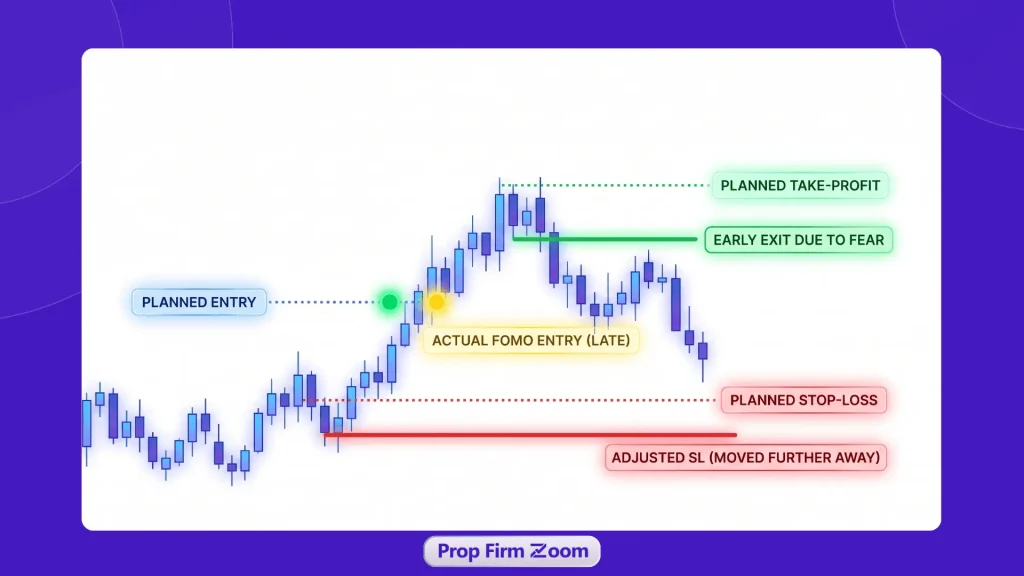
Over multiple trades, this review can reveal recurring patterns. For example, a trader may consistently enter too early, close winning positions too quickly, or hold losing trades longer than planned. Identifying these patterns is one of the main benefits of post trade analysis.
Reviewing Risk and Position Sizing
Risk management is particularly important when trading under prop firm rules because losses directly affect the available drawdown. Post trade analysis should therefore examine whether the position size was appropriate for the account and the specific setup.
A trader may have a profitable strategy but still struggle with a prop firm evaluation because individual positions are too large relative to the account’s drawdown limits. Reviewing position size across multiple trades can show whether risk remains consistent or increases after losses and winning streaks.
This is also where traders can identify whether their actual risk matches their intended risk. If position sizing changes significantly based on confidence, recent results, or emotions, the trade review can expose that inconsistency before it has a major impact on the account.
Reviewing Stop Loss and Take Profit Decisions
Stop loss and take profit decisions should also be examined after each trade. Traders can compare the levels planned before entering the position with what actually happened during the trade.
A review may reveal that stop losses are regularly placed too close to the entry, causing otherwise valid setups to close prematurely. It may also show that take profit levels are being moved because of fear or greed rather than changes in market structure.
For prop traders, these decisions have an additional dimension because repeated small losses or unnecessarily large losses can gradually reduce the account’s drawdown buffer. Reviewing stop loss and take profit behavior can therefore help traders determine whether their trade management is compatible with the risk limits of the prop firm.
Reviewing Trade Execution and Management
The final part of the review is examining how the trade was executed and managed after the position was opened. Even when the original analysis was correct, poor execution or emotional management can change the outcome.
Traders can review whether the order was entered at the intended price, whether the position size matched the plan, and whether the trade was managed according to the original strategy. For short term strategies, execution quality can be particularly important because small differences in entry and exit prices may affect the overall risk to reward profile.
Over time, this type of review helps distinguish between a problem with the trading strategy and a problem with execution. That distinction is valuable when evaluating both personal performance and the practical trading conditions provided by a prop firm.
Post Trade Analysis of Your Performance During a Prop Firm Evaluation
A prop firm evaluation should be reviewed as a complete trading process rather than judged only by whether the profit target was reached. Post trade analysis allows traders to examine how they performed throughout the evaluation, how much risk they took, and whether their trading behavior remained consistent with the firm’s requirements.

Reviewing performance during the evaluation can also help identify problems before they result in a failed account. Instead of waiting until the end of the challenge, traders can use their trade history to identify patterns and adjust their approach while there is still time to improve.
Reviewing Winning and Losing Trades
Winning and losing trades should both be included in a performance review. Focusing only on profitable trades can create a misleading picture of performance because a few large winners may hide inconsistent execution or excessive risk.
When reviewing winning trades, traders should consider whether the result came from a well executed setup or from taking more risk than planned. Losing trades should be examined in the same way. A loss that followed the trading plan may be completely acceptable, while a small loss caused by an impulsive decision may reveal a more important problem.
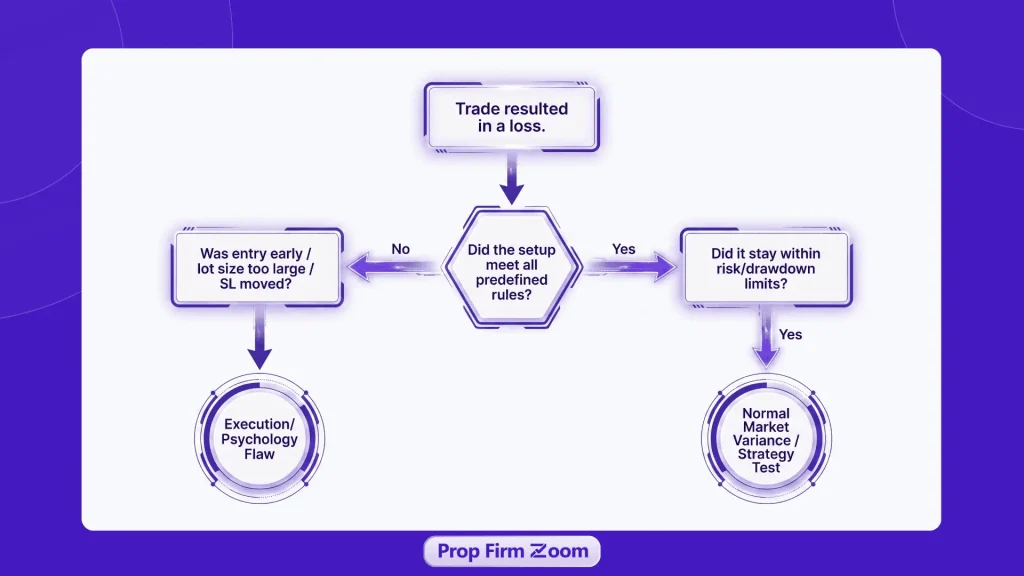
Comparing both types of trades can help traders identify which setups perform consistently and which decisions repeatedly lead to poor results. This creates a more accurate picture of performance than simply looking at the account’s current profit or loss.
Reviewing Drawdown and Daily Loss Limits
Drawdown and daily loss limits deserve particular attention during a prop firm evaluation. A trader can have a profitable strategy and still fail an evaluation by allowing a short series of losses to consume too much of the available risk.
Post trade analysis helps traders understand how individual positions contribute to overall drawdown. Reviewing the size and timing of losses can reveal whether certain trading sessions, market conditions, or position sizes consistently create larger declines in account equity.
Daily loss limits should also be reviewed in relation to the trader’s normal risk. If a few consecutive trades can bring the account close to its daily limit, the strategy may require adjustments even if its long term results are positive.
This type of review helps traders understand not only how much they are losing, but how those losses interact with the specific risk structure of the prop firm evaluation.
Reviewing Compliance With Prop Firm Rules
Performance should also be reviewed from a rule compliance perspective. Passing an evaluation requires more than generating enough profit; trades must generally remain within the firm’s permitted trading behavior and risk parameters.
Reviewing trade history can help identify whether the trader consistently followed the firm’s requirements regarding position size, leverage, holding periods, prohibited strategies, trading hours, or other restrictions. It can also reveal situations where a trader came close to violating a rule even if no actual breach occurred.
This is particularly useful because repeated near violations may indicate that the trading strategy does not fit comfortably within the firm’s framework. A trader who frequently approaches a drawdown limit or relies on behavior restricted by the firm may need to reconsider the strategy before moving to a funded account.
Reviewing Repeated Trading Mistakes
The final stage of a performance review is identifying mistakes that appear repeatedly rather than treating each losing trade as an isolated event. A single mistake may have little significance, but the same mistake occurring across multiple trades can have a measurable impact on evaluation performance.
For example, a trader may repeatedly enter positions too early, increase position size after a loss, move stop losses further away, or take trades outside the original strategy. Post trade analysis makes these patterns easier to recognize because the trader can compare decisions across a larger sample of trades.
Once a recurring mistake has been identified, the next step is to determine how it affects the prop firm evaluation. If the behavior consistently increases drawdown, reduces consistency, or creates a higher risk of violating the firm’s rules, it becomes a performance issue that should be addressed before continuing with the evaluation.
A structured review therefore turns the evaluation from a simple pass or fail challenge into an opportunity to understand how effectively a trading strategy works within a prop firm’s specific conditions.
What Post Trade Analysis Can Add to a Prop Firm Review
A prop firm review usually focuses on the firm’s rules, trading conditions, evaluation structure, drawdown limits, and payout policies. While these factors are important, they do not show how a trader’s own strategy and decision making perform under those conditions. Post trade analysis adds this missing perspective by using actual trading data to evaluate the experience from the trader’s side.
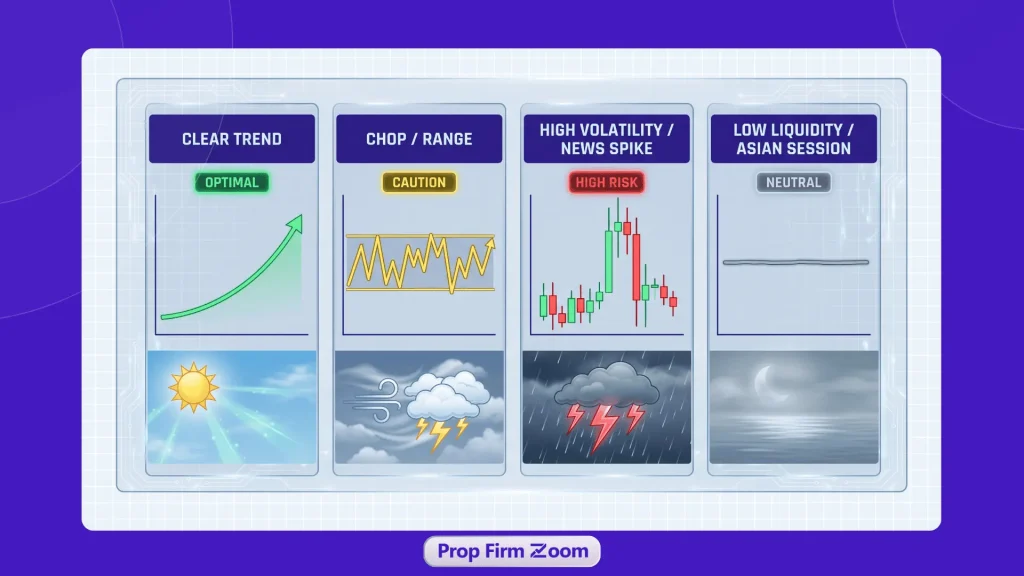
When combined with a prop firm review, post trade analysis can help traders understand whether their results are influenced primarily by the firm’s conditions, their trading strategy, or the way they execute and manage trades.
Identifying Trading Strengths and Weaknesses
Reviewing completed trades can reveal which parts of a trader’s process are working well and which areas need improvement. A trader may consistently identify strong setups but struggle with trade management, or may manage positions effectively while entering trades too early.
These strengths and weaknesses become particularly relevant when trading with a prop firm. A strategy that performs well under normal market conditions may become more difficult to execute when combined with strict drawdown limits or other trading restrictions.
By analyzing actual trades alongside the conditions described in a prop firm review, traders can determine whether their weaknesses are personal trading issues or whether they are being amplified by the firm’s specific requirements.
Finding Patterns in Trading Performance
Individual trades rarely provide enough information to evaluate a trading process. Patterns become more visible when traders review a larger number of positions and compare their results over time.
Post trade analysis can reveal recurring relationships between market conditions, trade setups, position sizes, and outcomes. For example, a trader may discover that most losses occur during certain market conditions or that performance deteriorates after a series of consecutive trades.
These patterns can add useful context to a prop firm review. Instead of judging a firm’s conditions based on a single trading experience, traders can examine how those conditions interact with their strategy across multiple trades and sessions.
Separating Strategy Problems From Execution Errors
Not every losing trade indicates that the underlying strategy is ineffective. Sometimes the setup is valid but the trade is poorly executed, while in other cases the execution is correct but the strategy itself produces unfavorable results under certain conditions.

Post trade analysis helps separate these two situations. Traders can compare the original setup with the actual execution and determine whether the position followed the strategy as intended.
This distinction is important when evaluating a prop firm. If a strategy produces poor results even when executed correctly, the issue may be the strategy or its compatibility with the firm’s conditions. If the strategy performs well when followed but results deteriorate because of impulsive decisions or poor execution, the trader may need to address their own process instead.
Evaluating Trading Consistency
Consistency is another area where post trade analysis can add depth to a prop firm review. A trader may reach a profit target quickly, but that does not necessarily mean the underlying process is stable or repeatable.
Reviewing trade size, risk, execution, and decision making over a larger sample can show whether performance remains relatively consistent or depends on occasional large winners. It can also reveal whether risk increases after losses or whether trading behavior changes significantly as the account approaches its profit target or drawdown limit.
For prop traders, this distinction matters because evaluation rules are designed around specific risk boundaries. A trading approach that produces short term gains but regularly creates large fluctuations may be less compatible with a prop firm’s account structure than a slower but more controlled approach.
This is where post trade analysis becomes a valuable complement to a prop firm review. The review explains what the firm requires, while the trader’s own data helps determine whether their strategy and behavior can operate consistently within those requirements.
Conduct a Prop Firm Trade Review
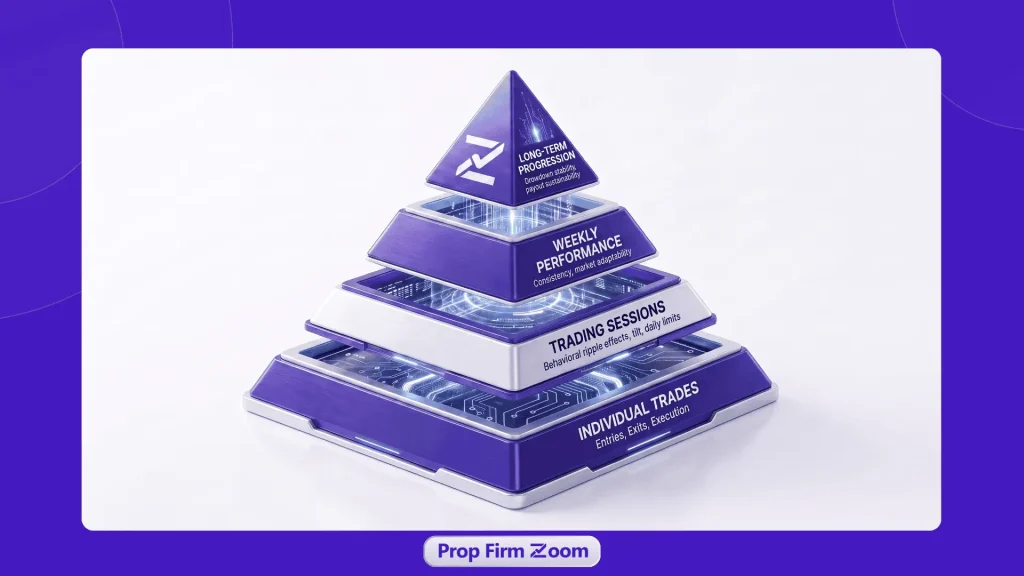
A useful prop firm trade review should go beyond checking the final profit or loss of an account. Traders can review their performance at different levels, starting with individual positions and gradually looking at entire trading sessions and longer periods. This makes it easier to identify both isolated mistakes and recurring patterns that may affect performance during a prop firm evaluation or funded account.
Reviewing Individual Trades
The first level of a prop firm trade review is the individual position. Once a trade is closed, traders can compare what actually happened with the original trading plan. This includes reviewing the setup, entry, position size, risk, stop loss, take profit, execution, and final outcome.
The purpose is not to judge every trade simply as a win or loss. Instead, the trader should determine whether the position was executed according to the strategy and whether any decisions made during the trade changed its expected risk or outcome.
Reviewing individual trades can also reveal small behavioral patterns. A trader might notice that entries are frequently taken before confirmation, stop losses are moved after entering, or profitable positions are closed earlier than planned. These observations become more valuable when the same behavior appears across multiple trades.
Reviewing Trading Sessions
After individual trades have been reviewed, traders can examine the entire trading session. This broader view can reveal how decisions made earlier in the session affected later trades.
For example, a strong early profit may lead to increased confidence and larger positions, while an early loss may encourage revenge trading or unnecessary attempts to recover the account. Looking at the sequence of trades rather than each position separately can make these behavioral patterns much easier to identify.
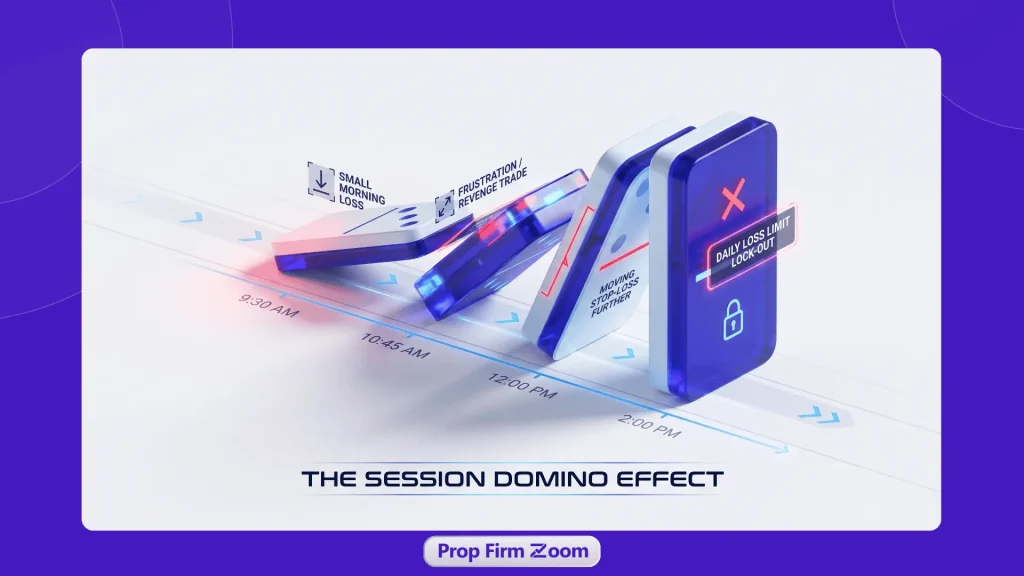
Session level reviews are particularly useful for prop traders because daily loss limits and other account restrictions operate within specific trading periods. Understanding how trading behavior changes throughout a session can help traders determine whether their approach remains consistent as profits and losses accumulate.
Reviewing Weekly Performance
A weekly performance review provides a larger sample of trading activity and makes it easier to distinguish isolated events from recurring issues. Instead of focusing on individual trades, traders can examine how consistently they followed their strategy, managed risk, and stayed within the prop firm’s requirements throughout the week.
This review can also show whether performance varies significantly between different market conditions or trading days. A strategy may perform well during trending markets but struggle during periods of low volatility or sudden price movements.
For traders participating in a prop firm evaluation, weekly reviews can also provide an early indication of whether the current approach is sustainable. If most of the week’s profits came from one or two unusually large trades while the remaining positions were inconsistent, the overall result may not accurately represent the quality of the trading process.
Comparing Results Over Time
The final stage is comparing performance across multiple weeks or evaluation periods. This makes it possible to determine whether improvements identified through previous trade reviews are actually producing better results.
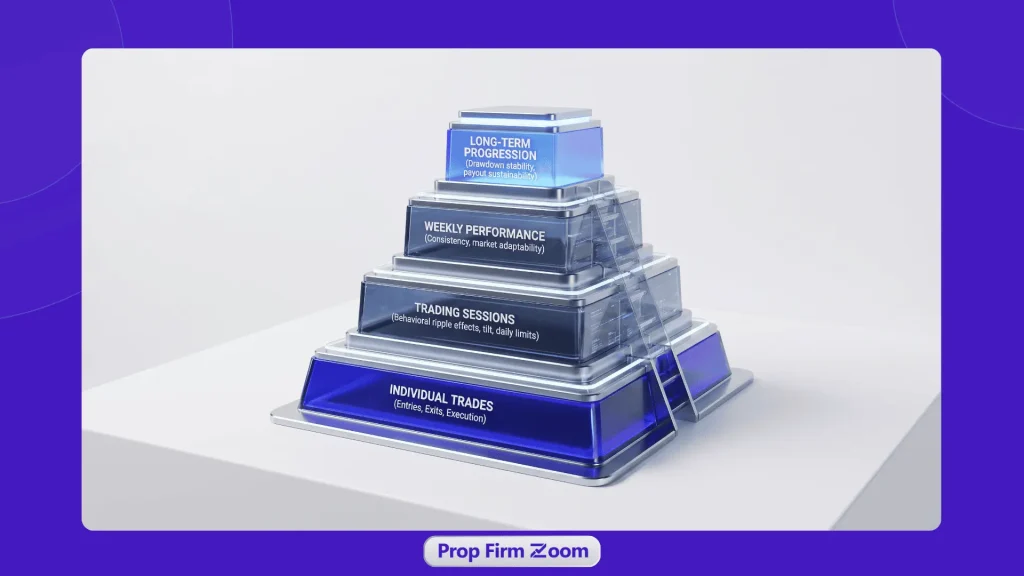
Longer term comparisons can reveal changes in win rate, average risk, drawdown, trade frequency, execution quality, and consistency. More importantly, they can show whether the trader is becoming better at following the strategy and adapting to the conditions imposed by the prop firm.
Comparing results over time also adds useful context when reading a prop firm review. A single evaluation or trading period may not provide enough information to understand how a trader performs under the firm’s rules. A longer record can show whether the same strategy remains effective and whether the trader can maintain consistent risk management across different market conditions.
A structured review process therefore turns post trade analysis into an ongoing performance tool rather than a one time exercise. By moving from individual trades to sessions, weekly results, and longer term performance, prop traders can build a clearer picture of what is working and what needs to change.
Including Post Trade Analysis in a Prop Firm Review
A comprehensive prop firm review should examine more than the advertised account size, profit target, and pricing. Trading performance provides important context for understanding how the firm’s rules and conditions may affect traders in practice. Post trade analysis can help evaluate these factors using actual trading activity rather than relying only on the firm’s published information.
Trade Execution and Market Conditions
Trade execution can have a significant effect on trading results, particularly for strategies that depend on precise entries and exits. A prop firm review should consider the trading environment in which positions are executed, including available instruments, order execution, spreads, liquidity, and the conditions traders experience during different market situations.
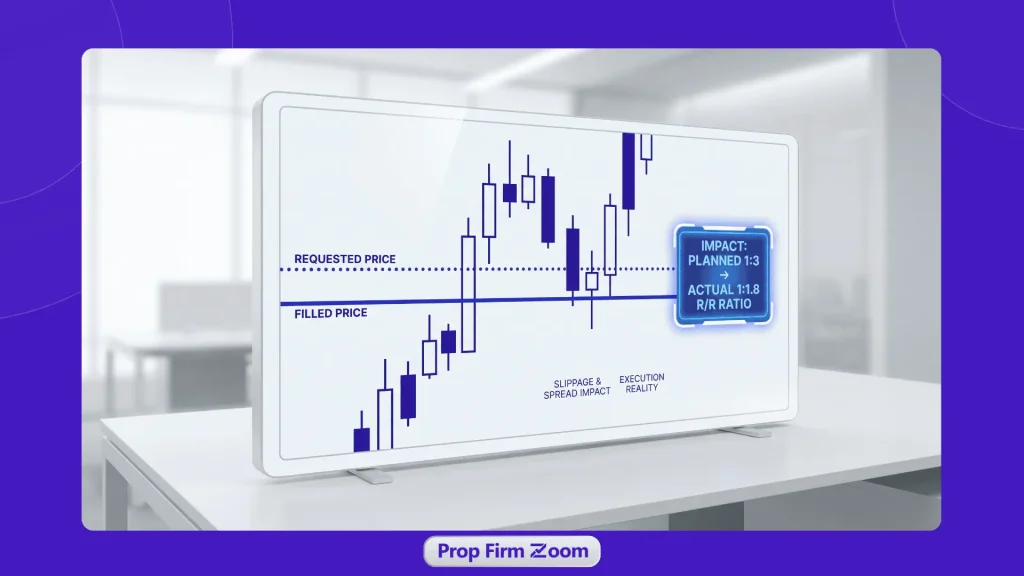
Post trade analysis can add another perspective by showing whether execution consistently matches the trader’s expectations. If repeated differences between planned and actual entries or exits affect performance, traders can investigate whether the issue comes from their own execution process or the trading environment provided by the prop firm.
Market conditions should also be considered when reviewing results. A strategy may perform differently during high volatility, low liquidity, strong trends, or ranging markets. Understanding these conditions helps prevent traders from attributing every change in performance to the prop firm itself.
Risk Management and Drawdown
Risk management is one of the most important areas to examine in a prop firm review because the firm’s drawdown structure directly affects how traders can manage positions. Maximum drawdown, daily loss limits, and other risk restrictions determine how much room a trader has to withstand losing trades.
Post trade analysis can show how a trader’s actual risk compares with these limits. A strategy that appears profitable may still be difficult to maintain if normal losing streaks regularly consume a large portion of the available drawdown.
Reviewing risk over a larger sample can also show whether position sizing remains consistent. This provides a better indication of how practical the firm’s drawdown conditions are for a particular trading approach.
Trading Rules and Restrictions
Trading rules should be evaluated in the context of actual trading behavior rather than simply listed in a prop firm review. Restrictions involving leverage, holding periods, news trading, position sizes, prohibited strategies, or other trading activities can have a direct impact on how a trader executes a strategy.
Post trade analysis can help determine whether these rules interfere with normal trading decisions. If a trader repeatedly has to modify a strategy because of specific restrictions, that information can provide useful context when evaluating the prop firm’s overall trading environment.
The key question is not simply whether a rule exists, but whether the rule materially changes how the trader can operate. A restriction that has little effect on one strategy may be highly significant for another.
Payout Performance and Account Results
Payout performance is another important part of a prop firm review because passing an evaluation does not necessarily tell the full story of the trading experience. Traders should also consider what happens after an account becomes profitable and whether the firm’s payout conditions are practical for the way they trade.
Account results can be reviewed alongside the trading process that produced them. Consistent profitability with controlled drawdown provides a different picture from an account that reaches a payout through a small number of high risk trades.
Post trade analysis can therefore add context to payout and account performance. It helps explain how profits were generated, how much risk was required to achieve them, and whether the same approach appears sustainable under the firm’s rules.
When these factors are considered together, a prop firm review becomes more useful to traders. Instead of focusing only on advertised conditions, the review can provide a clearer picture of how trading execution, risk management, rules, and account performance interact in practice.
Post Trade Analysis Complements a Prop Firm Review
A prop firm review and post trade analysis answer two different questions. A prop firm review examines the conditions a trader is expected to operate under, while post trade analysis examines how the trader actually performs within those conditions. Looking at both perspectives can provide a more complete understanding of the trading experience.

Reviewing the Trader vs. Reviewing the Prop Firm
Reviewing a prop firm means examining factors such as its evaluation rules, drawdown structure, trading restrictions, execution conditions, and payout policies. The purpose is to understand what the firm offers and what traders are required to follow.
Post trade analysis takes the opposite perspective. Instead of evaluating the firm, the trader evaluates their own decisions, risk management, execution, and results. This distinction is important because poor trading performance does not necessarily indicate that a prop firm’s conditions are unfavorable, just as a favorable review of a firm does not guarantee that its rules will suit every trading strategy.
Keeping these two types of review separate allows traders to identify whether a problem comes from the firm’s conditions or from their own trading process.
Using Trade Data to Understand Prop Firm Rules
Prop firm rules can look straightforward when presented on a website, but their practical impact may only become clear after trading under them. Trade data can help demonstrate how specific requirements affect actual positions and account performance.
For example, reviewing historical trades alongside daily loss limits and maximum drawdown can show how much room a strategy has before approaching an account restriction. Similarly, analyzing position sizes and holding periods can reveal whether certain trading restrictions require meaningful changes to the trader’s normal approach.
This makes post trade analysis useful when interpreting a prop firm review. Rather than treating every rule as an isolated condition, traders can consider how those requirements interact with their strategy and risk management.
Putting Prop Firm Reviews Into Trading Context
A prop firm review provides information that is useful before opening an account, but traders also need to understand how that information relates to their own trading style. The same rules can have very different consequences for a scalper, swing trader, or trader who relies on larger position sizes.

Post trade analysis provides the personal context that a general prop firm review cannot provide. By comparing actual trading results with the firm’s rules and conditions, traders can determine whether the firm’s structure fits their strategy and whether their current approach remains practical within the account’s limitations.
This also helps prevent overly broad conclusions. A rule that creates a significant challenge for one type of trader may have little impact on another. Reviewing both the firm and the trader creates a more balanced assessment.
Why Both Reviews Matter for Prop Traders
A prop firm review helps traders understand the environment they are entering, while post trade analysis helps them understand their own performance within that environment. Neither perspective is sufficient on its own.
A trader may choose a prop firm with suitable rules and competitive conditions but still struggle because of inconsistent risk management or poor execution. Conversely, a trader with a sound strategy may find that certain firm specific restrictions make the strategy difficult to execute effectively.
Using both forms of review creates a more complete evaluation process. The prop firm review establishes whether the firm’s conditions are suitable, while post trade analysis shows whether the trader can operate successfully within those conditions.
For this reason, post trade analysis is a useful complement to a prop firm review. It connects the firm’s published rules with real trading behavior and helps traders make more informed decisions about both their performance and the prop firms they choose.
Build a Post Trade Review Process for Prop Trading
Post trade analysis is most effective when it becomes a consistent part of the trading routine rather than something done only after a major loss or a failed evaluation. A structured review process allows prop traders to record what happened, identify recurring problems, and measure whether changes to their trading approach are actually improving performance.
Creating a Prop Firm Trade Review Checklist
A consistent checklist can make post trade reviews more objective and prevent traders from focusing only on the final profit or loss. The review should cover the original trade setup, entry and exit decisions, position size, risk, execution, and compliance with the prop firm’s trading rules.
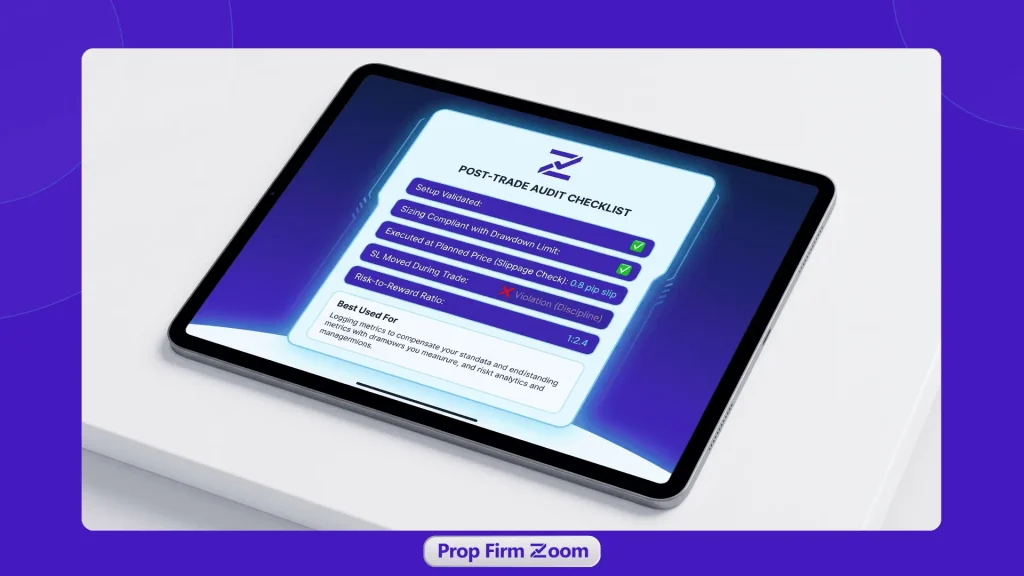
The purpose of a checklist is not to make every trade look perfect. Instead, it creates a consistent framework for evaluating decisions. Using the same process after each trade makes it easier to compare positions and identify patterns that might otherwise be overlooked.
The checklist can also be adapted to the specific requirements of the prop firm. If a firm has strict daily loss limits, drawdown rules, or position restrictions, those conditions should be included in the review process so the trader can evaluate performance in the context of the actual account rules.
Recording Trading Mistakes and Lessons
Recording mistakes immediately after a trade helps prevent them from becoming recurring habits. A useful trade journal should explain what went wrong, why the decision was made, and whether the mistake was related to strategy, execution, risk management, or trading psychology.
Not every losing trade represents a mistake. A position can lose money while still being executed correctly according to the strategy. The purpose of recording lessons is therefore to distinguish normal trading outcomes from decisions that can be improved.
Over time, these records create a history of the trader’s behavior. Reviewing that history can reveal repeated mistakes, such as increasing risk after losses, entering without confirmation, or changing a stop loss during a trade.
Tracking Performance Across Prop Firm Evaluations
Comparing results across different evaluation periods can provide a broader view of trading performance. Instead of treating each challenge as an isolated attempt, traders can examine whether the same patterns appear from one evaluation to another.
This comparison can include profitability, drawdown, risk per trade, trade frequency, and consistency. More importantly, it can show whether adjustments made after previous evaluations actually improved the trading process.
Tracking performance across evaluations can also help traders determine whether a particular prop firm’s conditions suit their strategy. If performance changes significantly under different rule structures, the difference may provide useful information when evaluating future prop firm options.
Turning Trade Reviews Into Actionable Improvements
The final step is turning observations from the review process into specific changes. Identifying that a trader frequently takes oversized positions is useful, but the review becomes much more valuable when that observation leads to a clear adjustment in position sizing or risk management.
Changes should be measurable whenever possible. A trader might decide to reduce risk after consecutive losses, follow predetermined stop loss levels more strictly, or limit the number of trades taken during a session. The goal is to create a change that can be evaluated through future trading data.
After implementing a change, the trader can return to the same post trade review process and compare the results with previous performance. This creates a continuous feedback loop in which trades are reviewed, problems are identified, adjustments are made, and the effect of those adjustments is measured over time.
For prop traders, this process can make post trade analysis much more than a trading journal. It becomes a practical system for improving decision making, managing risk, and understanding how effectively a trading strategy fits within a prop firm’s rules.
Frequently Asked Questions About Post Trade Analysis in Prop Firm Reviews
What is post trade analysis in prop trading?
Post trade analysis is the process of reviewing completed trades to evaluate decisions, risk management, execution, and results. For prop traders, it also helps determine how effectively their trading approach works within a firm’s specific rules and account conditions.
Why is post trade analysis important for prop traders?
Post trade analysis helps traders identify recurring mistakes, understand their risk exposure, and evaluate whether their strategy is being executed consistently. It can also reveal whether certain prop firm rules are affecting their trading performance.
How does post trade analysis relate to a prop firm review?
A prop firm review evaluates the firm’s rules, trading conditions, drawdown structure, and payout policies, while post trade analysis evaluates the trader’s performance under those conditions. Using both provides a more complete view of the trading experience.
What should I review after a prop firm trade?
Traders should review the original setup, entry and exit decisions, position size, risk, stop loss and take profit decisions, execution, and whether the trade followed the prop firm’s rules. Reviewing multiple trades can also reveal recurring patterns that are not visible from a single position.
Can post trade analysis help me pass a prop firm evaluation?
Yes. Reviewing trades can help identify behaviors that increase the risk of hitting daily loss limits or maximum drawdown. It can also help traders recognize repeated execution and risk management problems before they cause an evaluation failure.
How often should prop traders conduct a trade review?
Individual trades can be reviewed shortly after they close, while broader performance can be reviewed at the end of each trading session and week. Longer term reviews can then be used to compare performance across multiple evaluation periods.
What is the difference between a prop firm review and a trade review?
A prop firm review evaluates the firm and its conditions, while a trade review evaluates the trader’s individual decisions and performance. A prop firm review asks whether the firm’s structure is suitable, whereas a trade review asks whether the trader is executing effectively within that structure.
Can post trade analysis show whether a prop firm suits my trading strategy?
It can provide useful evidence. By comparing trading results, risk exposure, and execution with the firm’s rules and restrictions, traders can determine whether the account structure and trading conditions are compatible with their strategy.