What Is Reverse Trading in Prop Firms and How to Review It?
Reverse trading is a trading practice that involves taking opposite positions, often across multiple trading accounts. In prop trading, understanding how reverse trading works and how each firm defines it is important because rules can vary significantly between companies. A strategy that is permitted by one prop firm may violate the trading rules of another.
What Is Reverse Trading?
Reverse trading generally refers to taking opposing positions on the same market. In a prop firm environment, this often means opening a long position on an asset in one account while taking a short position on the same or a closely related asset in another account.
For example, a trader might open a long BTC position in one prop firm account and a short BTC position in another. The two positions move in opposite directions, meaning a gain on one account can correspond with a loss on the other.
However, reverse trading should not automatically be confused with changing the direction of a trade within a single account. Closing a long position and later opening a short position is a normal part of trading and does not necessarily constitute prohibited reverse trading. The firm’s specific rules determine what activities fall under its definition.
How Reverse Trading Works in Prop Firms
The most important distinction when reviewing reverse trading is whether the opposite positions are taken within the same account or across multiple accounts.
A trader can normally change from long to short within a single account as part of a regular trading strategy. The situation becomes more relevant to prop firm rules when opposing positions are opened across separate accounts.
For example:
- Account A: Long BTC
- Account B: Short BTC
Some prop firms may allow this type of trading, while others may classify it as prohibited hedging, coordinated trading, or an attempt to reduce trading risk across accounts.
Reverse trading can also involve accounts held by different traders. Some firms specifically prohibit coordinated opposite positions between related or unrelated accounts, while others focus only on activity across accounts controlled by the same trader.
How Prop Firms Define Reverse Trading
There is no universal definition of reverse trading across the prop firm industry. Each company can define the practice differently and may use related terms such as hedging, opposite positions, coordinated trading, or account to account trading in its rules.
For this reason, reviewing a prop firm’s actual trading terms is more important than relying on a general definition of reverse trading. A company may permit normal position reversals within an account while prohibiting opposite positions between multiple accounts. Another firm may impose broader restrictions on hedging or coordinated trading.
When comparing prop firms, traders should therefore look beyond whether a company simply states that reverse trading is allowed or prohibited. The important question is how the firm defines reverse trading and which accounts, positions, and trading behaviors its rule covers.
Why Do Prop Firms Restrict Reverse Trading?
Prop firms may restrict or prohibit reverse trading because taking opposite positions across accounts can create risks that are different from those of normal trading. In particular, reverse trading can affect how a firm evaluates trading performance, manages account exposure, and detects coordinated strategies across multiple accounts.
Understanding why these restrictions exist can make it easier to review a prop firm’s rules and understand the difference between a permitted trading strategy and a prohibited attempt to reduce evaluation or account risk.
Risk Management and Account Exposure
One reason prop firms restrict reverse trading is the way opposing positions can affect overall account exposure.
For example, a trader could take a long position on BTC in one account and a short position on BTC in another. Although each account has its own profit and loss, the trader’s combined exposure across the accounts can be significantly different from the exposure shown by either account individually.
This can make it more difficult for a prop firm to assess the trader’s actual market risk, particularly when multiple accounts are involved. Firms may therefore restrict strategies that effectively offset risk between accounts.
Evaluation Manipulation
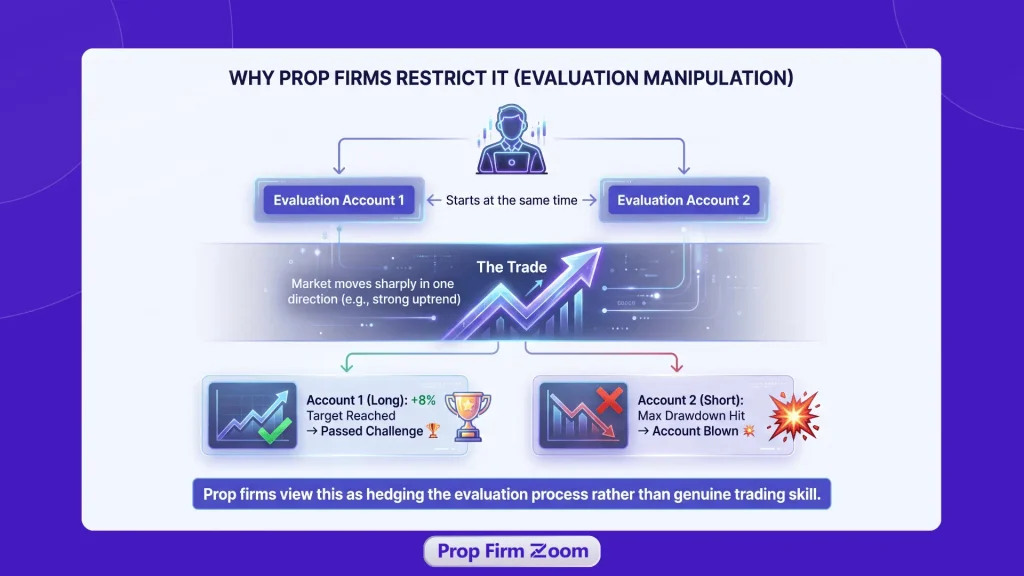
Reverse trading can also be restricted because it may be used to reduce the risk of failing an evaluation.
For example, a trader could take opposite positions across two evaluation accounts. If the market moves in one direction, one account may gain while the other loses. The trader could then continue with the account that performed well while abandoning the losing account.
From the firm’s perspective, this can create a situation where the trader’s apparent success does not necessarily reflect the same level of trading skill or risk management that the evaluation is designed to measure.
For this reason, some prop firms treat certain forms of reverse trading as an attempt to manipulate or circumvent the evaluation process.
Hedging Across Multiple Accounts
Another common reason for restrictions is cross account hedging.
A trader may use one account to hold a long position and another account to hold a short position on the same asset. While this can reduce the trader’s overall market exposure, it can also allow risk to be distributed between accounts rather than managed within a single trading strategy.
Some prop firms therefore prohibit or restrict hedging between accounts, even when they do not explicitly use the term reverse trading.
This is why traders should review both the firm’s reverse trading and hedging policies. A strategy may be restricted under one rule even if the other rule does not mention it directly.
Coordinated Trading and Rule Circumvention
Prop firms may also restrict reverse trading to prevent coordinated trading between multiple accounts or traders.
For example, two accounts could deliberately take opposite positions on the same asset, with the expectation that one account will profit while the other absorbs the loss. If this activity is coordinated, the accounts could effectively be used together rather than being evaluated as independent trading strategies.
Firms may therefore include rules against coordinated trading, account manipulation, or attempts to circumvent trading restrictions. These rules can apply not only to accounts owned by the same trader but, depending on the firm’s terms, to accounts controlled by related traders.
Ultimately, the reason behind a reverse trading restriction is usually broader than simply preventing traders from taking opposite positions. Prop firms want their evaluations and funded accounts to reflect genuine trading performance under the firm’s risk rules. Understanding this context makes it easier to interpret reverse trading policies and compare how different prop firms approach the strategy.
Review of Reverse Trading Prop Firms
Reverse trading rules vary significantly across prop firms. Some firms allow traders to take opposite positions across accounts, while others restrict the practice or prohibit it entirely. The key difference is often not whether a trader can change direction within a single account, but whether the firm permits opposing positions across multiple accounts or considers them a form of hedging or coordinated trading.
Prop Firms That Allow Reverse Trading
Some prop firms allow reverse trading, meaning traders can hold opposing positions under certain circumstances. However, allowed does not necessarily mean that every form of reverse trading is permitted.
For example, a firm may allow a trader to reverse a position within the same account while also allowing opposite positions across separate accounts. Another firm may allow the practice but impose limits on the number of accounts involved or prohibit coordinated trading between accounts.
Crypto Fund Trader allows reverse trading under its stated trading rules. Traders should still review the firm’s specific conditions regarding multiple accounts, hedging, and coordinated positions before assuming that every form of opposite trading is permitted.
Fundednext also permits reverse trading, but its rules should be reviewed for any account level or strategy specific restrictions.
For each firm, the complete review should explain exactly what is allowed rather than simply labeling the firm as reverse trading friendly.
Prop Firms With Restrictions on Reverse Trading
Some prop firms do not completely prohibit reverse trading but place restrictions on how and where it can be used.
These restrictions may apply to:
- Opposite positions across multiple accounts
- Accounts owned by the same trader
- Accounts belonging to different traders
- Hedging between accounts
- Coordinated or mirrored trading
- Evaluation accounts versus funded accounts
Hyrotrader falls into this category if its rules permit certain forms of reverse trading while restricting others. In these cases, traders should read the exact wording of the firm’s trading rules before using an opposing position strategy.
A restricted policy can be more difficult to interpret than a simple allowed or prohibited rule. For this reason, our review considers not only whether reverse trading is permitted, but also where the restrictions apply and what trading behavior can trigger a violation.
Prop Firms That Prohibit Reverse Trading
Some prop firms explicitly prohibit reverse trading or related forms of opposite position trading. These restrictions may be particularly relevant when a trader operates multiple accounts.
A prohibition can cover activities such as taking opposite positions across accounts, coordinating trades with another trader, or using separate accounts to hedge exposure.
breakout prohibits the relevant forms of reverse trading under its trading rules. Traders using multiple accounts should pay particular attention to the firm’s definitions of hedging, coordinated trading, and prohibited strategies.
A firm that prohibits reverse trading may also impose consequences for violations, including account termination or the loss of trading profits or payout eligibility. The exact consequences depend on the firm’s terms.
When reviewing a prop firm’s reverse trading policy, the most important point is therefore not simply whether the firm allows or prohibits the strategy. Traders should also determine which type of reverse trading is covered by the rule, which accounts are affected, and what happens if the rule is violated.
Review of Reverse Trading Rules Across Prop Firms
Reverse trading policies can differ significantly between prop firms, even when multiple firms use similar terminology. A firm may allow reverse trading in one situation while restricting it in another, particularly when multiple accounts, hedging, or copied trades are involved.
For this reason, reviewing reverse trading rules requires looking at more than a simple allowed or prohibited label. The following criteria help compare how prop firms handle different forms of reverse trading.
Multiple Account Rules
Multiple account rules are one of the most important factors to review when comparing reverse trading policies. Some prop firms allow traders to hold opposing positions across their own accounts, while others consider this a prohibited form of hedging or account manipulation.
The rules may also differ depending on how the accounts are related. A firm could allow normal trading across several accounts but prohibit opening opposite positions on the same asset at the same time.

When reviewing a firm’s multiple account policy, check whether it addresses:
- Opposite positions across accounts owned by the same trader
- Opposite positions across different account sizes
- Trading the same asset in opposite directions
- Simultaneous or near simultaneous positions
- Restrictions on the total number of accounts
A clear distinction between multiple account trading and reverse trading across accounts is important because having multiple accounts does not automatically mean that opposite positions are permitted.
Hedging Rules
Reverse trading and hedging can overlap, but prop firms do not necessarily treat them as identical practices. Some firms specifically prohibit hedging, while others use broader language covering opposite positions or risk offsetting strategies.
For example, a trader might hold a long BTC position in one account and a short BTC position in another. A prop firm may classify this as cross account hedging even if its rules do not explicitly use the term reverse trading.
When reviewing hedging rules, check whether the prop firm restricts:
- Hedging within the same account
- Hedging across multiple accounts
- Opposite positions on correlated assets
- Simultaneous long and short positions
- Hedging between accounts controlled by different traders
This distinction matters because a firm’s reverse trading policy may be stated under its hedging rules rather than under a section specifically called reverse trading.
Copy Trading Rules
Copy trading can create a separate issue when reviewing reverse trading policies. A trader may not manually open opposite positions but could use multiple accounts or trading tools to replicate, mirror, or coordinate trades.
Prop firms may allow copy trading under certain conditions while prohibiting strategies that create opposing positions across accounts. Others may restrict copying between accounts owned by different traders or prohibit external trade coordination altogether.

When reviewing these rules, consider whether the firm allows:
- Copying trades between your own accounts
- Copying trades between different traders
- Automated trade replication
- Mirrored positions across accounts
- Coordinated trading strategies
Copy trading rules are particularly relevant when a firm’s definition of prohibited trading extends beyond the individual account and focuses on the relationship between multiple accounts.
Evaluation and Funded Account Rules
Reverse trading rules may also differ between the evaluation stage and the funded account stage. A strategy that appears acceptable during an evaluation is not necessarily permitted after an account becomes funded.
Some firms apply the same trading rules throughout the entire account lifecycle, while others impose additional restrictions once traders reach the funded stage. The firm’s rules may also distinguish between different account types or programs.

When reviewing a prop firm’s policy, check whether reverse trading restrictions apply to:
- Evaluation accounts
- Funded accounts
- Multiple evaluation accounts
- Multiple funded accounts
- Accounts under different programs
Checking these differences is important because traders should understand the rules that will apply after passing the evaluation, not just the rules they encounter while completing the challenge.
Overall, a useful reverse trading review should compare these areas together rather than relying on a single allowed or prohibited label. The same prop firm may allow one form of reverse trading while restricting another, so understanding the exact scope of each rule is essential before using the strategy.
Reverse Trading vs. Hedging and Copy Trading in Prop Firm Reviews
Reverse trading is sometimes used interchangeably with hedging or copy trading, but these terms do not necessarily describe the same trading behavior. This distinction is important when reviewing prop firm rules because a company may prohibit one practice while allowing another.
Reverse Trading vs. Hedging
Reverse trading and hedging can involve opposite positions, but the terms describe different concepts.
Reverse trading generally refers to taking an opposite position, particularly across multiple accounts. Hedging is a broader risk management approach in which a trader takes a position intended to offset the risk of another position.
For example, a trader might hold a long BTC position in one account and a short BTC position in another. A prop firm could classify this as reverse trading, cross account hedging, or both, depending on its rules.
The important point when reviewing a prop firm’s policy is that the firm’s definition takes priority over the general trading terminology. A company may use the term hedging to cover behavior that traders would otherwise describe as reverse trading.
Reverse Trading vs. Copy Trading
Copy trading is different from reverse trading because it concerns the replication of trades rather than taking the opposite side of a position.
For example, if a trader opens a long BTC position and the same trade is automatically replicated across several accounts, this is copy trading. If one account takes a long position while another takes a short position, the behavior may be considered reverse trading.
However, the two practices can overlap. A trader could use a copy trading system to replicate opposite strategies across multiple accounts. This is why some prop firms include copy trading in their rules concerning coordinated or prohibited trading.
When reviewing a prop firm, it is therefore important to check both policies rather than assuming that permission to copy trades also means permission to reverse trade.
Reverse Trading vs. Normal Position Reversal
Normal position reversal is different from the type of reverse trading that many prop firms regulate.
A trader can normally close a long position and then open a short position on the same asset. This is simply changing the direction of a trade within the same account.
For example:
Long BTC → Close the position → Short BTC
This does not necessarily involve multiple accounts or offsetting positions. By contrast, reverse trading in the context of prop firm restrictions often refers to holding opposing positions across accounts or coordinating opposite trades.

This distinction is important when reviewing prop firm rules. A firm that prohibits reverse trading may not be prohibiting ordinary changes in trade direction. Traders should therefore read the specific rule to determine whether it applies to position reversals within one account, opposing positions across accounts, or coordinated trading between multiple accounts.
What Happens If You Break Reverse Trading Rules?
Breaking a prop firm’s reverse trading rules can have serious consequences, particularly when the activity involves multiple accounts, prohibited hedging, or coordinated trading. The consequences depend on the firm’s terms and the type of violation, but they can range from a rule violation being recorded to account termination and the loss of trading profits or payout eligibility.
Before using a reverse trading strategy, traders should understand not only whether the practice is allowed but also what happens if the firm’s rules are violated.
Account Rule Violations
A reverse trading violation occurs when a trader engages in activity that falls outside the prop firm’s permitted trading rules. This could include taking prohibited opposite positions across accounts, using multiple accounts to hedge exposure, or coordinating trades with another trader when such activity is restricted.

The severity of a violation can depend on the firm’s rules and the specific circumstances. Some firms may review the trading activity before taking action, while others may treat a clearly prohibited strategy as a direct breach of the account terms.
When reviewing a prop firm’s policy, check whether the company clearly explains what constitutes a reverse trading violation and how violations are handled.
Account Termination
In more serious cases, a prop firm may terminate an account after identifying prohibited reverse trading activity. This can apply to evaluation accounts as well as funded accounts, depending on the firm’s terms.
Account termination may occur when a trader deliberately uses multiple accounts to create opposing positions, attempts to circumvent risk limits, or engages in another form of prohibited coordinated trading.
The exact enforcement process varies between firms. Some companies may identify violations through automated monitoring and then conduct a review, while others may apply their trading rules directly when prohibited activity is detected.
For this reason, traders should review the firm’s terms before assuming that a reverse trading strategy is acceptable simply because the positions themselves are technically possible on the platform.
Profit and Payout Consequences
A reverse trading violation can also affect profits and payouts. Depending on the firm’s rules, prohibited trading activity may result in profits being removed, a payout request being rejected, or the trader becoming ineligible for a payout.
The consequences can vary considerably between prop firms. Some may distinguish between profits generated before and after a violation, while others may treat the entire account as invalid once a serious rule breach is confirmed.
This makes the payout policy an important part of any reverse trading prop firm review. Traders should check not only whether reverse trading is allowed, but also what happens to account profits and payout eligibility if the firm determines that the strategy violated its rules.
Ultimately, the safest approach is to review the firm’s specific reverse trading, hedging, and multiple account rules before trading. If the wording is unclear, traders should not assume that an opposing position strategy is permitted simply because the firm does not explicitly use the term reverse trading.
How to Choose a Prop Firm for Reverse Trading
Choosing a prop firm for reverse trading requires more than finding a company that simply states that reverse trading is allowed. Prop firms can apply different restrictions to multiple accounts, hedging, copy trading, and coordinated positions. Before choosing a firm, review the specific rules that apply to the trading strategy you intend to use.
Check the Prop Firm’s Reverse Trading Policy
Start by checking the firm’s official trading rules for a clear definition of reverse trading. Look for information about opposing positions, position reversals, and whether the rules apply to a single account or multiple accounts.
A clear policy is preferable because vague wording can make it difficult to determine whether a particular strategy is permitted. If the firm does not explicitly address the type of reverse trading you plan to use, avoid assuming that it is allowed.
Review Multiple Account Restrictions
If you plan to trade multiple accounts, pay particular attention to rules covering opposite positions between those accounts.
Check whether the prop firm allows:
- Opposing positions across your own accounts
- Multiple accounts trading the same asset
- Simultaneous long and short positions
- Coordinated trading between different traders
This is often the most important part of a reverse trading policy because a firm may allow normal trading across multiple accounts while prohibiting opposing positions between them.
Check Hedging and Copy Trading Rules
Finally, review the firm’s hedging and copy trading policies. A prop firm may not use the term reverse trading in its rules but may prohibit the same behavior under its hedging or coordinated trading provisions.
Check whether the firm restricts hedging between accounts, copying trades across accounts, or using automated systems to replicate trading activity.
The best prop firm for reverse trading is therefore not necessarily the one with the simplest allowed label. It is the one whose reverse trading, multiple account, hedging, and copy trading rules clearly permit the specific strategy you intend to use.

Frequently Asked Questions About Reverse Trading Prop Firm Review
Is Reverse Trading Allowed in Prop Firms?
Reverse trading is allowed by some prop firms but restricted or prohibited by others. The rules can also vary depending on whether the opposite positions are taken within one account or across multiple accounts. Always check the firm’s current trading rules before using a reverse trading strategy.
Which Prop Firms Allow Reverse Trading?
Some prop firms allow reverse trading with no restrictions, while others permit it only under specific conditions. The firms reviewed in this guide are categorized based on their published rules, including restrictions related to multiple accounts, hedging, and coordinated trading.
Is Reverse Trading the Same as Hedging?
Not necessarily. Reverse trading often involves taking opposite positions, particularly across multiple accounts, while hedging is a broader risk management practice used to offset exposure. However, some prop firms may classify certain forms of reverse trading as hedging under their trading rules.
Can You Reverse Trade Across Multiple Prop Firm Accounts?
It depends on the prop firm’s rules. Some firms allow opposing positions across multiple accounts, while others prohibit or restrict them. Before trading in opposite directions across accounts, check the firm’s rules regarding multiple accounts, hedging, and coordinated trading.
Can Reverse Trading Get a Funded Account Banned?
Yes. If a prop firm prohibits the type of reverse trading you use, violating the rule can result in account termination and may affect profits or payout eligibility. The specific consequences depend on the firm’s terms and the severity of the violation.