
What Are Prop Firm Add Ons?
Prop firm pricing can include more than the advertised cost of an evaluation or trading account. Some firms offer additional features, rule changes, or account upgrades for an extra fee. These are commonly referred to as prop firm add ons.
An add on can change an important part of an account, such as its drawdown, profit split, leverage, payout conditions, or trading restrictions. However, not every fee charged by a prop firm should be considered an add on.
For a meaningful prop firm review, it is important to separate the base account price, mandatory fees, optional add ons, and account upgrades. This makes it easier to understand the actual cost of an account and compare prop firms on equivalent trading conditions.
What Is the Base Account Price?
The base account price is the advertised cost of a standard prop firm account before optional features or upgrades are added.
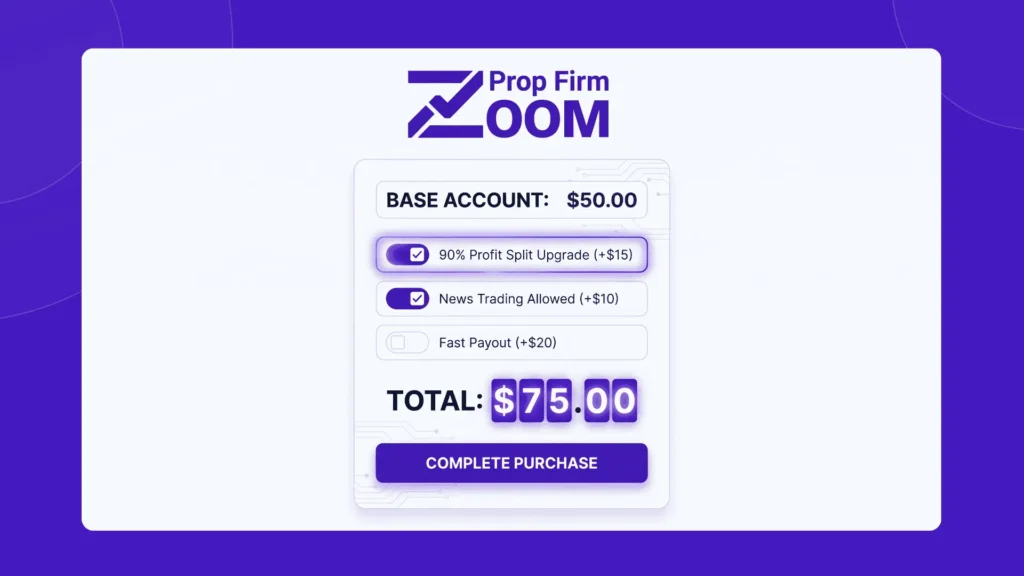
For example, a prop firm may offer a $50 evaluation account with a defined profit target, maximum drawdown, profit split, and trading rules. If a trader purchases that account without selecting any additional features, the $50 represents the base account price.
The base price is usually the first number traders see when comparing prop firms. It can be useful for understanding the entry cost, but it does not necessarily represent the total cost of getting the trading conditions a trader wants.
Two prop firms may advertise accounts at a similar price while offering very different rules. One firm may include additional drawdown or a higher profit split in its standard account, while another may charge extra for the same features.
For this reason, a prop firm review should not evaluate pricing based only on the headline account price. The review should also identify what is included in the standard account and which features require an additional payment.
What Are Mandatory Prop Firm Fees?
A mandatory prop firm fee is a charge that a trader must pay to access an account or a particular stage of a program. Because the trader cannot reasonably avoid the charge, it should not be treated as an optional add on.

For example, suppose a prop firm charges a $10 activation fee after a trader passes an evaluation. If every trader who reaches the funded stage must pay that fee, it is a mandatory cost rather than an optional add on.
Other examples may include required platform fees, mandatory data fees, or other charges that apply to all traders under a particular account structure.
The distinction matters because mandatory fees are part of the actual cost of the account. A prop firm advertising a $50 evaluation with a required $10 activation fee does not have a $50 total required cost if the trader must eventually pay the additional $10.
A prop firm review should therefore report mandatory charges separately from optional add ons while still including them when calculating the total required cost.
This also prevents a pricing comparison from becoming misleading. Optional features should not be used to inflate the apparent cost of a standard account, while mandatory fees should not be presented as if they were features traders can simply choose to ignore.
What Are Optional Prop Firm Add Ons?
An optional prop firm add on is an additional feature, account benefit, or rule modification that a trader can purchase for an extra fee but does not have to purchase.
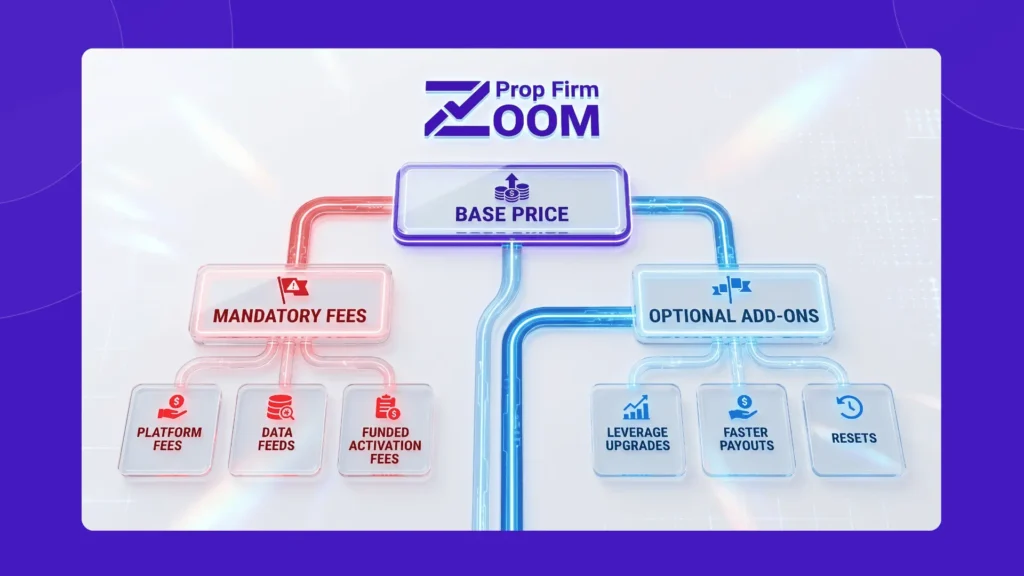
The important characteristic is choice. A trader should be able to purchase the standard account without selecting the add on.
Common examples can include:
- Additional drawdown
- A higher profit split
- Higher leverage
- Weekend holding
- News trading
- Faster payouts
- Account resets
- Larger account allocations
- Additional trading features
The specific add ons available vary considerably between prop firms. Some firms offer only a few optional upgrades, while others provide a long list of features that can be added during checkout.
However, the number of add ons does not tell a trader whether the pricing is good or bad. What matters is what each add on changes, how much it costs, and whether the benefit is relevant to the trader’s strategy.
Consider two hypothetical firms:
Firm A: $49 base account + $15 drawdown add on
Firm B: $59 base account with the same drawdown included
Firm A has the lower advertised price, but a trader who needs the additional drawdown would pay $64. Firm B may therefore be cheaper for that particular trader despite having the higher headline price.
This is why add on pricing is an important part of a prop firm review. A review should look beyond the initial price and consider the cost of obtaining comparable trading conditions.
Prop Firm Add On Upgrades
A prop firm add on upgrade is an additional payment that improves or expands an existing account feature.

For example, a firm might allow a trader to upgrade:
- An 80% profit split to 90%
- Standard drawdown to extended drawdown
- Standard leverage to higher leverage
- A smaller account allocation to a larger one
- Standard payout timing to faster payouts
The terminology is not always consistent across the industry. One prop firm may call a feature an “add on,” another may call it an “upgrade,” and another may include it as part of a different account package.
For a prop firm review, the label is less important than the economic effect.
If a trader has to pay an additional $20 to receive a feature that is included in another firm’s standard account, that cost should be considered when comparing the two firms.
Upgrades should also be evaluated based on whether they apply only to the evaluation stage or continue into the funded stage. A higher profit split during the evaluation may have little practical value if the upgrade does not affect the trader’s eventual funded account.
The same applies to drawdown, leverage, payout conditions, and other account features. A review should explain exactly what the trader receives for the additional payment and when that benefit actually applies.
One Time vs Recurring Add On Costs
Another important distinction is whether an add on is paid once or continues to generate costs over time.

A one time add on cost is paid once when the trader purchases or upgrades the account. Examples may include a fixed fee for additional drawdown, a reset, or a particular account upgrade.
A recurring add on cost is charged repeatedly. Depending on the firm’s pricing model, this could be a monthly fee, a fee for each payout period, or another recurring charge tied to maintaining a particular feature.
The difference can have a significant impact on the real cost of an account.
For example:
Firm A: $20 one time add on
Firm B: $5 monthly add on
Firm B appears cheaper at first, but the recurring fee reaches $20 after four months and continues increasing afterward. If the feature is needed for a longer period, the difference becomes even more significant.
A prop firm review should therefore identify whether each additional cost is:
- One time
- Recurring
- Conditional
- Charged only when a specific feature is used
Conditional costs deserve particular attention. A fee may not apply to every trader, but it can still materially affect the total cost for traders who use a particular feature or reach a specific stage of the program.
Ultimately, Prop Firm Zoom evaluates add on costs separately from the base account price and mandatory fees. The goal is not simply to count how many add ons a prop firm offers. It is to understand what each one changes, how much it costs, when the cost applies, and whether the additional benefit provides meaningful value compared with the standard account or competing prop firms.
Why Add On Costs Matter in Prop Firm Reviews
The advertised price of a prop firm account is often the easiest number to compare, but it does not always represent the cost of getting the trading conditions a trader actually needs.

Optional add ons can change the economics of an account significantly. A lower priced account may become more expensive once a trader adds the drawdown, profit split, payout terms, or trading features they consider important. At the same time, a more expensive account may include those features in its standard price.
This is why add on costs should be part of a comprehensive prop firm review rather than treated as a minor pricing detail.
Advertised Price vs Real Cost
The advertised account price shows what a trader pays for the standard version of an account. The real cost can be higher if the trader needs additional features or encounters fees later in the account lifecycle.
For example, consider two hypothetical prop firms:
Firm A: $39 base price + $20 drawdown add on
Firm B: $55 base price with the same drawdown included
Firm A appears cheaper when comparing only the advertised prices. However, for a trader who considers the additional drawdown essential, the relevant comparison is $59 versus $55.
The same principle applies to other features. A trader may need a higher profit split, weekend holding, higher leverage, faster payouts, or a reset option. If these features require additional payments, the headline account price does not provide a complete picture of the cost.
This does not mean the advertised price is misleading by itself. It simply means that the price should be viewed in the context of what is included.
A prop firm review should therefore distinguish between the base price and the cost of obtaining specific trading conditions. This makes the comparison more useful for traders who have different strategies and requirements.
How Add Ons Change a Prop Firm Comparison
Add ons can change the outcome of a prop firm comparison because firms do not always package the same features in the same way.
One firm may include extended drawdown in its standard account, while another may offer it as a paid upgrade. One may include a higher profit split by default, while another may charge an additional fee to unlock it.
This creates a problem when traders compare accounts using price alone.
A more meaningful comparison asks whether the accounts provide equivalent conditions.
For example:
Firm A: $49 account + $15 drawdown upgrade
Firm B: $59 account with equivalent drawdown included
The relevant comparison is not simply $49 versus $59. If the trader needs the additional drawdown, the comparison becomes $64 versus $59.
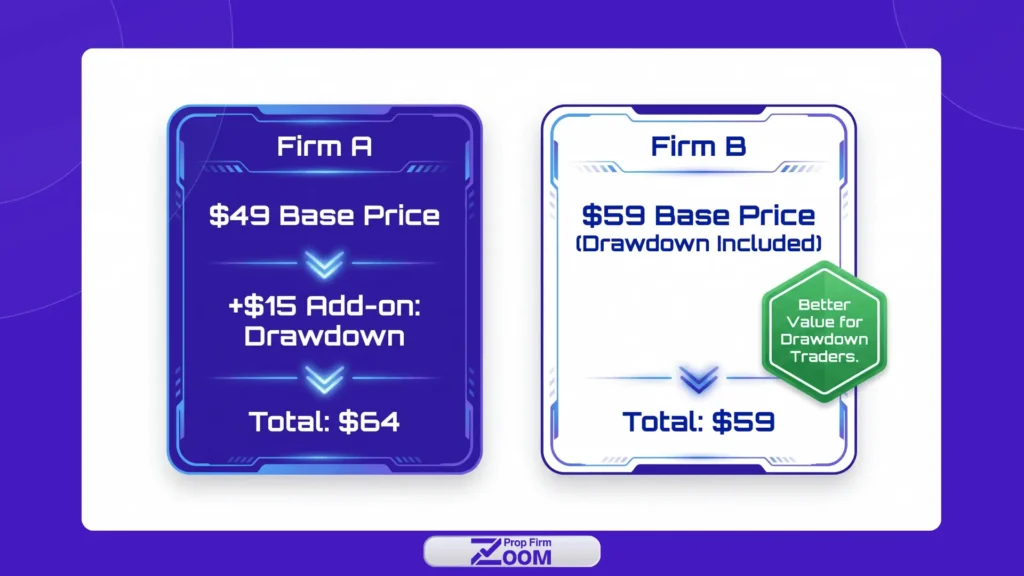
The same approach can be applied to profit splits, account allocations, payout conditions, leverage, and other features.
Add ons can also make comparisons more difficult when they affect different stages of the program. An upgrade that applies only during the evaluation may have a different value from one that continues into the funded stage.
For this reason, a prop firm review should consider three questions:
- What does the standard account include?
- What does the add on change?
- What would the trader pay to obtain equivalent conditions elsewhere?
This approach moves the comparison away from headline pricing and toward the actual economics of the account.
When a Higher Total Cost May Be Better
A higher total cost does not automatically mean that a prop firm offers worse value.
An account that costs more may provide trading conditions that are significantly more useful to a particular trader. For example, paying more for additional drawdown could make sense for a strategy that regularly experiences larger temporary losses before reaching its target. Similarly, a higher profit split may justify an additional fee if the trader expects to generate enough profit for the upgrade to pay for itself.
The important question is not simply how much does the account cost? but what does the additional cost provide?
Consider a simplified example:
Firm A: $50 account with standard drawdown
Firm B: $70 account with substantially higher drawdown
If the additional drawdown gives a trader more room to operate within their strategy, the $20 difference may represent meaningful value. For another trader who rarely uses the available drawdown, the same upgrade may provide little benefit.
This is why add on costs should be evaluated in relation to the trader’s actual use case.
A higher total cost may be justified when an add on:
- Provides a meaningful improvement to the trading conditions
- Removes a restriction that affects the trader’s strategy
- Increases usable drawdown or other important account capacity
- Improves payout economics
- Costs less than obtaining the same conditions from another prop firm
On the other hand, an expensive add on may provide poor value when it offers a feature the trader does not need or simply increases the nominal account size without materially improving the trading conditions.
For Prop Firm Zoom, the goal is therefore not to identify the prop firm with the lowest combination of base price and add on costs. The goal is to determine whether the total cost is reasonable for the conditions being provided.
A low cost account with expensive essential upgrades may offer less value than a higher priced account that includes the same conditions from the beginning. Conversely, paying for unnecessary upgrades can make an otherwise affordable account unnecessarily expensive.
That distinction is an important part of evaluating the real cost of a prop firm account.
Common Prop Firm Add Ons
Prop firms can offer a wide range of optional features and account upgrades. Some change the risk parameters of an account, while others affect payouts, trading restrictions, account size, or access to specific platforms and markets.
The cost and structure of these add ons can vary significantly between firms. A feature that is included in one account may be sold as an upgrade by another firm, making it important to look at both the price and the conditions attached to it.
A prop firm review should therefore identify the most relevant add ons, explain what each one changes, and evaluate whether the additional cost provides meaningful value.
Drawdown Add On Costs
Drawdown is one of the most important account conditions a trader can modify through an add on.

A prop firm may offer additional drawdown for an extra fee, allowing traders to operate with a larger maximum loss or daily loss limit. The add on may increase the overall drawdown percentage, change the type of drawdown, or provide a different risk structure.
For example, a firm could offer a standard account with a 6% maximum drawdown and allow traders to purchase an extended drawdown option for an additional fee.
When reviewing a drawdown add on, the price alone is not enough. A review should consider how much additional drawdown the trader receives and whether the change applies during the evaluation, funded stage, or both.
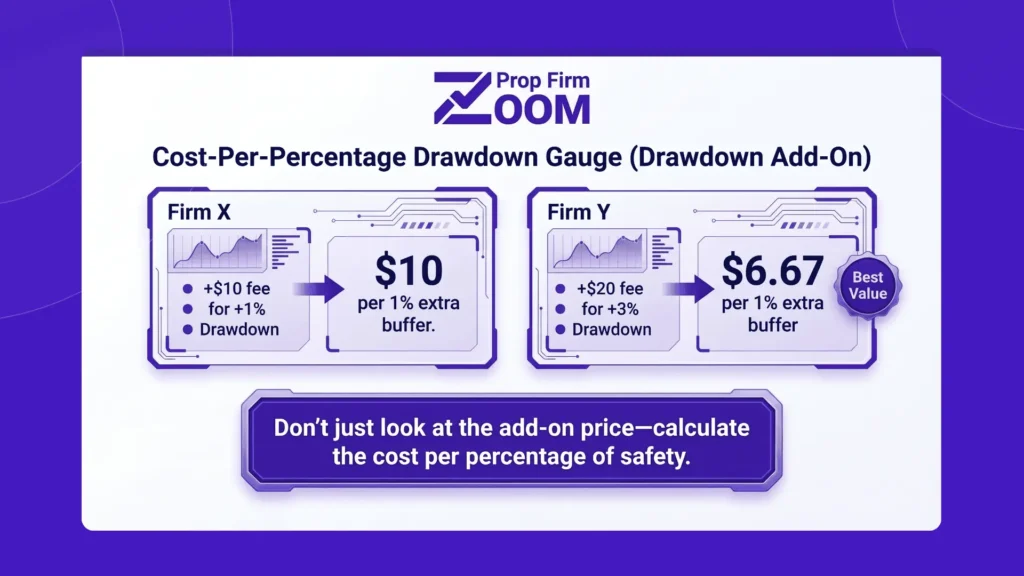
The cost can also be evaluated on a per percentage basis. For example, a $10 add on that provides an additional 1% of drawdown can be compared more directly with a $20 add on providing an additional 3%.
The key question is whether the additional drawdown materially improves the account’s risk conditions relative to its cost.
Profit Split Add Ons
Some prop firms allow traders to pay for a higher profit split.
For example, a standard account may offer an 80% profit split while an optional upgrade increases the trader’s share to 90% or more.
The value of this type of add on depends heavily on the trader’s expected profits. A higher profit split may have little practical value for a trader who generates limited profits, while it can become significant for a consistently profitable funded trader.

A review should therefore consider the cost of the upgrade alongside the additional percentage received.
It is also important to determine whether the higher split applies immediately, only after reaching a certain milestone, or only to specific stages of the program.
For recurring profit split upgrades, the potential cost should be compared with the additional payout generated by the higher split. This makes it possible to determine when the upgrade reaches its break even point.
Scaling Add On Costs
Scaling add ons can provide access to a larger account allocation or allow traders to increase their account size under different conditions.
For example, a prop firm may offer a standard scaling plan but allow traders to pay for a larger allocation or faster scaling through an optional upgrade.
The headline account size can make these offers appear attractive, but nominal account size is not the only factor that matters. A larger account may come with the same percentage drawdown, different risk limits, or additional restrictions.
A prop firm review should therefore look at the amount of usable trading capacity created by the upgrade rather than focusing only on the nominal account balance.

It should also compare the paid scaling option with the firm’s standard scaling program. If traders can reach the same allocation through normal account growth without paying an additional fee, the value of the scaling add on may be lower.
Reset and Retry Add Ons
Reset and retry options allow traders to restart an account or evaluation after a failure without purchasing an entirely new account.
The structure can vary considerably. A reset may restore the account to its original balance and rules, while a retry may provide another attempt under similar conditions.
The price is an important part of the comparison, but a review should also examine what happens to the original account conditions after the reset.
For example, traders should know whether an existing drawdown upgrade, higher profit split, or other add on remains active after a reset. A reset that requires the trader to repurchase previous upgrades can have a significantly higher effective cost than the advertised reset fee.
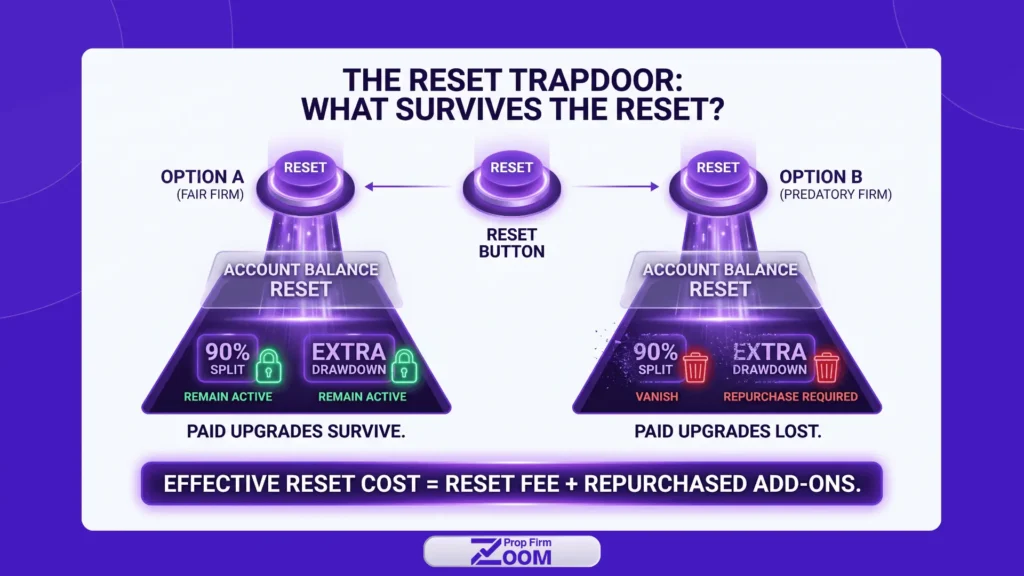
Prop Firm Zoom reviews should therefore consider the reset price together with the conditions attached to the new attempt.
Instant Funding Add Ons
Instant funding or fast track options can allow traders to access a funded style account without completing the standard evaluation process.

Depending on the prop firm, this may be offered as a separate product or as an optional upgrade to an existing account structure.
Because instant funding changes the path to the funded stage, it should not be compared directly with a standard evaluation based only on price.
A review should examine what the trader receives in exchange for the additional cost, including drawdown, profit split, payout conditions, account restrictions, and scaling rules.
The higher entry price may be reasonable if it provides materially different access to capital. However, traders should also compare the instant funding cost with the total cost and requirements of completing the firm’s standard evaluation.
News Trading Add Ons
Some prop firms restrict trading around major economic announcements, particularly in forex and futures programs. A news trading add on may allow traders to open or maintain positions during otherwise restricted periods.
The practical value of this feature depends on the trader’s strategy.
For a trader who does not trade economic news, the add on may provide little benefit. For a strategy that relies on volatility around major releases, the ability to trade during those periods can be important.
A prop firm review should determine exactly what the news trading add on permits. This may include whether traders can open new positions during restricted periods, hold existing positions through an announcement, or trade only certain instruments.
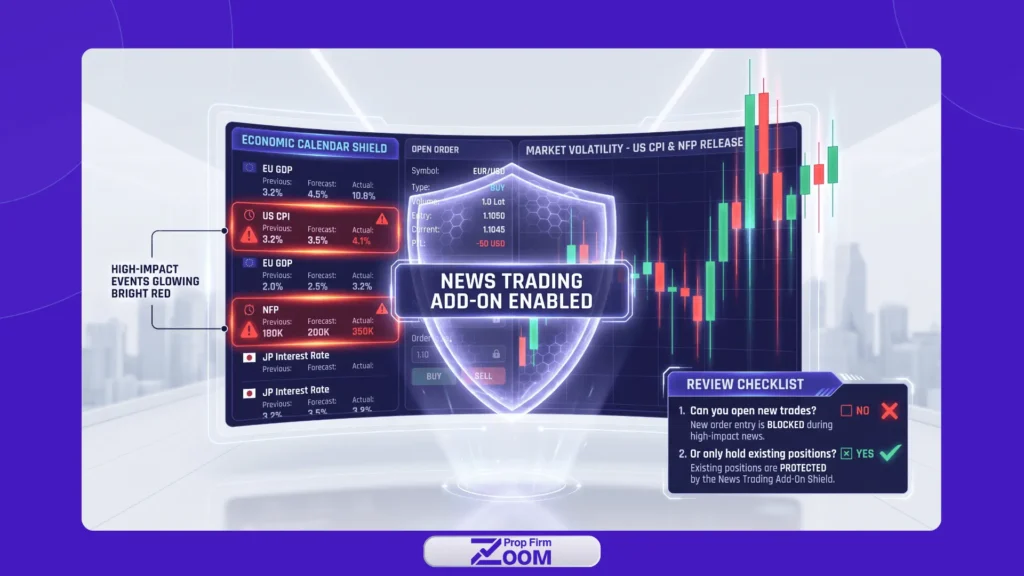
The review should also establish whether the feature applies during the evaluation, funded stage, or both.
Weekend Holding Add Ons
Weekend holding add ons allow traders to keep positions open through periods when the underlying market is closed or when the prop firm’s standard rules prohibit weekend positions.
This feature can be particularly relevant to swing traders and markets that operate differently across the week.
The value of a weekend holding add on depends on both the strategy and the asset class. A trader who regularly holds positions across weekends may consider it an important trading condition, while a day trader may have no reason to pay for it.
A review should clarify whether the add on allows positions to remain open throughout the weekend, whether new positions can be opened during the weekend, and whether different rules apply to different markets.
The cost should then be evaluated against the trader’s actual need for the feature.
Overnight Holding Add Ons
Overnight holding add ons allow traders to maintain positions beyond the firm’s standard daily trading window.
This can be important for swing traders or strategies that require positions to remain open for longer periods. It can be less relevant for traders who close all positions before the end of each trading session.
A review should examine whether the restriction applies to all instruments or only specific markets and whether the add on applies during both the evaluation and funded stages.
The distinction between overnight and weekend holding is also important. A prop firm may permit overnight positions while still requiring traders to close them before the weekend.
The add on cost should therefore be evaluated against the actual holding rules rather than simply being described as an increase in trading flexibility.
Higher Leverage Add Ons
Higher leverage add ons provide traders with greater nominal buying power for the same account size.
For example, a firm might offer standard leverage of 5:1 and allow traders to purchase a higher leverage option.
However, higher leverage does not automatically mean that an account provides more usable risk capacity. The account’s drawdown limits, position limits, margin requirements, and instrument specific rules still determine how much risk a trader can actually take.

This makes leverage add ons particularly important to evaluate in context.
A prop firm review should explain what the additional leverage applies to, which instruments are eligible, and whether the higher leverage changes the trader’s practical trading capacity.

It should also distinguish between higher leverage and higher drawdown. Increasing leverage can increase available exposure, but it does not necessarily increase the amount a trader can lose before violating the account’s rules.
Trading Platform Add Ons
Some prop firms charge additional fees for access to specific trading platforms, terminals, or advanced trading tools
A standard account may include one platform while a premium platform or additional terminal requires an upgrade.
Examples can include advanced charting platforms, professional trading terminals, analytics tools, or additional interfaces.
The value of a platform add on depends on what functionality it provides. A platform that offers better execution, more advanced order types, deeper market analysis, or tools that are directly relevant to the trader’s strategy may justify an additional cost.

A review should identify whether the platform is genuinely optional, whether an alternative platform is included for free, and whether the add on changes execution or simply provides a different interface.
Market Data and Execution Add Ons
Market data and execution features can also appear as paid upgrades.
These may include access to real time market data, additional exchanges or markets, market depth, DOM functionality, advanced order flow tools, or other execution related features.
The distinction between a data add on and a platform add on is important. A trader may have access to a platform but still need to pay for specific market data or advanced data feeds.
A review should examine what data is included in the base account, whether the additional data is necessary for the intended trading strategy, and whether the same information is available through another included platform.
Execution related upgrades also deserve careful attention. A more expensive execution package should be evaluated based on measurable improvements where possible rather than simply being described as “premium.”
Payout Add Ons
Payout add ons can change how and when traders receive their profits.
A prop firm may offer faster payouts, more frequent withdrawal opportunities, lower payout thresholds, or other enhanced payout conditions for an additional fee.
These upgrades can have a direct financial impact because payout timing affects how quickly traders can access their profits.
However, the value of a payout add on depends on both its cost and the standard payout conditions. A faster payout option may be attractive if the standard waiting period is long, but it may provide limited value when standard payouts are already frequent.
A review should therefore compare the upgraded payout terms with the standard terms and identify whether the additional fee is charged once, per payout, or on a recurring basis.
Account Size Add Ons
Account size add ons allow traders to purchase a larger nominal account allocation for an additional cost.
For example, a prop firm may offer a standard $50,000 account and allow traders to increase the allocation through a paid upgrade.
A larger account can appear attractive, but account size alone does not determine how much trading capacity a trader actually receives. Drawdown, leverage, position limits, and other rules can have a greater impact on usable risk capacity.
This makes account size add ons particularly important to evaluate on a relative basis.
Instead of asking only how much additional account size the trader receives, a prop firm review can examine the cost per additional $1,000 of nominal allocation and, where the information is available, the corresponding increase in usable drawdown.
The review should also compare paid account size upgrades with the firm’s standard scaling process. If the same allocation can be reached through normal scaling without an additional purchase, the paid upgrade may offer less value.
Ultimately, the purpose of reviewing account size add ons is not to reward the largest nominal balance. It is to determine whether the additional allocation provides meaningful trading capacity for the price.
How to Calculate the Real Cost of a Prop Firm Account
Comparing prop firm pricing based only on the advertised account price can produce a misleading result. The actual cost may include mandatory fees, optional add ons, resets, recurring charges, or other costs that appear later in the account lifecycle

A more useful approach is to calculate the cost based on the conditions a trader actually chooses. This makes it possible to compare prop firms on equivalent terms rather than simply comparing their lowest advertised prices.
Calculating the Initial Account Cost
The first step is to calculate how much the trader must pay to purchase the account with the features they want.
The basic formula is:
Real Initial Cost = Base Price + Mandatory Fees + Selected Add On
For example, assume a prop firm offers.
- Base account price: $49
- Mandatory activation fee: $10
- Drawdown add on: $15
- Higher profit split: $10
The initial cost would be:
$49 + $10 + $15 + $10 = $84
The advertised account price is $49, but the actual initial cost for the selected configuration is $84.
This distinction is important in prop firm reviews because not every trader will choose the same add ons. A review should therefore show both the standard account price and the cost of any optional features used in the comparison.
If a feature is not necessary for the comparison, it should not automatically be added to the account cost. The purpose is to calculate the cost of the conditions being evaluated, not to assume that every trader will purchase every available upgrade.
Calculating the Potential Total Cost
The initial purchase price is only one part of the potential cost.
Some prop firm programs can generate additional expenses later through recurring add ons, resets, retries, payout related charges, or other account services.
A broader formula can therefore be used:
Potential Total Cost = Initial Cost + Recurring Fees + Future Account Costs
For example, suppose a trader starts with an $84 initial cost and pays a $5 monthly fee for an optional feature.
After six months:
$84 + ($5 × 6) = $114
The trader has therefore paid $114 in total over that period, assuming the account remained active and no other costs were incurred.
This calculation should not be interpreted as the official cost of every prop firm account. The actual total depends on how long the account is maintained, which features are selected, and whether additional services are used.
For Prop Firm Zoom reviews, the purpose of this calculation is to show how a low initial price can produce a different long term cost when additional charges are included.
Factoring in Reset and Retry Costs
Reset and retry fees deserve separate attention because they are conditional costs.
A trader may never need a reset, while another trader may use the option multiple times. The cost therefore cannot always be added directly to the initial account price.
Instead, the review should identify the reset price and explain how it affects the potential cost of the program.
For example:
Initial account: $49
Reset: $20
If the trader resets the account once:
$49 + $20 = $69
If the trader resets twice:
$49 + ($20 × 2) = $8
This does not mean that the account costs $89 for every trader. It means that $89 represents the total cost under that particular scenario
This distinction is important when comparing prop firms. A firm with a low reset fee may appear attractive to traders who frequently use resets, while another firm may offer a more expensive reset but include additional benefits with each attempt.
A review should also check whether previous add ons remain active after a reset. If a trader has paid $15 for additional drawdown and must pay the same $15 again after resetting, the effective cost of the reset is higher than the advertised reset fee alone.
One Time vs Recurring Costs
The timing of an additional charge can be just as important as the amount.
A one time add on is paid once, while a recurring add on continues to generate costs over a defined period.
For example:
One time add on: $25
Recurring add on: $6 per month
The recurring option is initially cheaper, but after five months it has cost:
$6 × 5 = $30
At that point, the recurring option has become more expensive than the $25 one time charge.
A prop firm review should therefore identify the payment structure of each add on rather than listing only its price.
It is useful to distinguish between:
- One time costs
- Monthly or recurring costs
- Per payout costs
- Per reset costs
- Conditional costs
- Usage based costs
This makes the pricing structure easier to understand and prevents a recurring $5 charge from being treated as equivalent to a one time $5 upgrade.
When comparing firms, the relevant time period should also be considered. A recurring add on may be cheaper for a short term use case but more expensive over a longer period.
Calculating the Break Even Point
Break even analysis can help determine when paying for an add on becomes financially worthwhile.
The basic idea is to compare the additional cost of an upgrade with the additional financial benefit it provides.
For example, suppose a prop firm offers a higher profit split:
Standard profit split: 80%
Upgraded profit split: 90%
Cost of upgrade: $20
If a trader generates $500 in profit, the standard split would provide:
$500 × 80% = $400
The upgraded split would provide:
$500 × 90% = $450
The additional payout is therefore:
$450 − $400 = $50
Since the upgrade costs $20, the trader has already recovered the cost of the upgrade in this example.
The break even point can be calculated by determining how much additional profit is required to recover the upgrade fee.
In this example, the trader receives an additional 10% of profits through the upgrade. With a $20 upgrade cost:
$20 ÷ 10% = $200
So the trader would need to generate approximately $200 in profit for the additional 10% split to produce $20 in extra profit.
Above that level, the upgrade generates more additional profit than its cost. Below it, the upgrade has not yet recovered its fee.
The same principle can be applied to other add ons, although the calculation will depend on what the feature actually provides.
For example, a higher payout frequency can be evaluated based on the value of receiving funds earlier, while an additional drawdown upgrade may be more difficult to express as a direct monetary benefit.
This is why break even analysis should be treated as a decision making tool rather than a universal measure of add on value.
A prop firm review should ultimately consider the full relationship between cost, trading conditions, expected use, and potential benefit. An add on is not necessarily good value simply because it reaches break even quickly, and a more expensive add on is not automatically poor value.
The goal is to determine whether the additional cost is justified by a meaningful improvement in the account conditions.
Add On Costs vs Trading Conditions
The cost of a prop firm account should not be evaluated separately from the trading conditions attached to it. A low account price may look attractive, but restrictions on drawdown, profit targets, payouts, leverage, or trading activity can make the account less suitable for a particular strategy.
Add ons can change some of these conditions, which means their cost should be evaluated based on what they actually provide rather than simply added to the advertised account price.
For a meaningful prop firm review, the key question is not only how much an account costs, but what trading conditions the trader receives for that cost.
Account Price vs Trading Conditions
Two prop firm accounts with similar prices can provide very different trading conditions.

For example, consider two hypothetical accounts:
Firm A: $49 account with standard trading conditions
Firm B: $59 account with more flexible trading rules included
Firm A has the lower entry price, but that does not necessarily make it the better value account.
The difference could come from factors such as drawdown, profit targets, leverage, holding restrictions, payout rules, or trading limitations. If Firm A requires the trader to purchase additional features to obtain conditions similar to Firm B, the initial price difference becomes less meaningful.
This is why a prop firm review should evaluate price together with the conditions included in the standard account.
Add ons can make this comparison more complicated. A $49 account with $20 of necessary upgrades may be less attractive than a $65 account that already includes those conditions.
The right comparison is therefore based on price relative to trading conditions, not price in isolation.
Drawdown vs Account Size
Account size is one of the easiest prop firm features to compare, but it does not necessarily represent the amount of risk a trader can actually take.
A larger nominal account can still provide less usable risk capacity if it comes with a tighter drawdown.
For example:
Account A: $100,000 account with 5% maximum drawdown
Account B: $50,000 account with 10% maximum drawdown
Account A has twice the nominal balance, but both accounts provide $5,000 of maximum drawdown.
This becomes particularly important when a prop firm offers account size add ons. Paying more for a larger nominal account does not automatically provide proportionally more usable trading capacity.
The same principle applies to drawdown add ons. Increasing the drawdown percentage can sometimes have a more meaningful effect on a trader’s strategy than increasing the nominal account size.
A prop firm review should therefore consider both:
- Nominal account size
- Usable drawdown capacity
Where possible, comparing the cost per dollar of available drawdown can provide a more useful picture than comparing account balances alone.
Profit Target vs Additional Costs
The profit target is another important condition to consider when evaluating the cost of an account.
A low priced account may appear attractive, but a high profit target can make the evaluation more difficult to complete. Conversely, an account with a higher entry price and a lower target may offer conditions that better fit a conservative trading strategy.
Add ons can also affect this calculation indirectly. For example, an upgrade that increases drawdown may give a trader more room to operate while pursuing the same profit target.
Consider two hypothetical accounts:
Firm A: $49 account with a 10% profit target
Firm B: $65 account with a 7% profit target
The cheaper account is not necessarily the lower cost path to passing the evaluation. The trader must consider the relationship between the account price, profit target, drawdown, and probability of reaching the target without violating the rules.
This does not mean a lower profit target automatically makes an account better. The purpose of a review is to evaluate the overall relationship between the target and the rest of the account conditions.
If an add on changes the profit target or another evaluation requirement, its cost should be assessed alongside the practical impact of that change.
Payout Rules and Add On Economics
Payout conditions can significantly affect the value of a prop firm account, particularly when a trader becomes consistently profitable.
A payout add on might offer faster withdrawals, more frequent payout requests, a lower minimum threshold, or another improvement to the standard payout structure.
The cost of such an add on should be compared with the value it provides.
For example, paying $15 for a faster payout option may be reasonable for a trader who regularly withdraws profits and values earlier access to funds. The same fee may provide little benefit to a trader who withdraws infrequently.
The standard payout rules are therefore just as important as the upgraded conditions.
A prop firm review should examine:
- Standard payout frequency
- Minimum payout requirements
- Profit split
- Payout fees
- Waiting periods
- Any additional payout restrictions
- The cost of optional payout upgrades
This also illustrates why add on economics cannot always be reduced to a simple price comparison.
A $10 payout upgrade is not necessarily expensive or cheap on its own. Its value depends on what it changes and how frequently the trader is likely to use the feature.
Why a Cheap Prop Firm Account May Cost More
A low advertised price can be useful, but it should not be confused with a low overall cost.

A trader may start with a cheap account and then pay for several features needed to make the account suitable for their strategy. Once those costs are included, the final price may be higher than that of a competing firm with a more expensive base account.
For example:
Firm A
- Base price: $39
- Drawdown add on: $15
- Higher profit split: $10
- Payout upgrade: $10
- Total: $74
Firm B
- Base price: $65
- Equivalent conditions included
- Total: $65
Firm A wins the headline price comparison at $39, but Firm B is cheaper for a trader who requires all three features.
This does not mean Firm B is automatically the better prop firm. Other factors such as trading rules, execution, platform, payout reliability, and account restrictions still need to be reviewed.
The example simply demonstrates why cheap account pricing and low overall cost are not always the same thing.
For Prop Firm Zoom, add on costs are therefore evaluated as part of the broader trading conditions rather than as an isolated pricing metric. The objective is to determine what traders actually receive for the money they spend and whether the final cost is reasonable for the account’s rules and intended use.
How Add Ons Affect Prop Firm Comparisons
Comparing prop firms becomes more difficult when similar trading conditions are packaged differently.
One firm may include a feature in its standard account, while another may charge an additional fee for the same benefit. As a result, comparing only the advertised account price can make one firm appear cheaper even when the final cost is higher.
A more useful prop firm comparison adjusts for these differences. Instead of asking which firm has the lowest starting price, the comparison should examine what traders pay for equivalent trading conditions and what additional value they receive.
Comparing Base Prices With Equivalent Conditions
The first step is to compare accounts with similar trading conditions
.
For example:
Firm A: $49 account + $15 drawdown add on
Firm B: $59 account with equivalent drawdown included
If the trader needs the additional drawdown, comparing $49 with $59 does not provide the full picture. The relevant comparison is $64 for Firm A versus $59 for Firm B.
The same principle applies to profit splits, leverage, payout conditions, weekend holding, news trading, and other features.
A prop firm review should therefore identify which features are included in the base account and which require an additional payment before determining which account offers the lower effective cost.
This does not mean every comparison should include every available add on. The goal is to compare the conditions that are relevant to the specific use case.
Comparing Add On Costs as a Percentage
Looking at the dollar price of an add on can be useful, but comparing that price relative to the base account can provide additional context.
For example:
Firm A: $10 add on on a $50 account
Firm B: $15 add on on a $100 account
The first add on costs 20% of the base account price, while the second represents 15%.
The calculation is:
Add On Cost Percentage = Add On Cost ÷ Base Account Price × 100
In this example:
Firm A: $10 ÷ $50 × 100 = 20%
Firm B: $15 ÷ $100 × 100 = 15%
This does not mean Firm B automatically offers better value. The two add ons may provide different benefits, and the underlying accounts may have different trading conditions.
The percentage simply provides another way to understand how significant the additional cost is relative to the original account price.
This metric can be particularly useful when comparing similar add ons across accounts with very different base prices.
Comparing the Cost Per Benefit
An add on should also be evaluated based on what the trader actually receives for the additional payment.
Instead of looking only at the total add on price, a review can calculate the cost of a specific improvement.
For example, if a firm charges $10 for an additional 1% of drawdown:
Cost per additional 1% drawdown = $10
If another firm charges $18 for an additional 3%:
Cost per additional 1% drawdown = $6
The second add on has the lower cost per percentage point of additional drawdown, assuming the underlying conditions are otherwise comparable.
The same approach can be applied to other measurable features.
Cost per additional profit split percentage
If a trader pays $20 to increase their profit split from 80% to 90%:
$20 ÷ 10 percentage points = $2 per additional percentage point
Cost per $1,000 of account allocation
If a $50 add on increases the nominal account size by $10,000:
Cost per additional feature
$50 ÷ 10 = $5 per additional $1,000 of allocation
For features that cannot be expressed as a percentage or dollar amount, the review can simply compare the additional fee with the practical benefit provided.
These calculations should not be treated as universal measures of value. An additional 1% of drawdown, for example, may be far more important to one trading strategy than another.
Their purpose is to make pricing differences easier to identify and compare.
Comparing Included Features vs Paid Upgrades
One of the most important aspects of a prop firm comparison is determining whether a feature is included or sold separately.
Suppose three firms offer similar accounts:
Firm A: $49 account, higher profit split included
Firm B: $45 account, higher profit split costs $15
Firm C: $59 account, higher profit split and additional drawdown included
The lowest advertised price belongs to Firm B, but its effective price for the same conditions is $60.
This illustrates why included features can be more valuable than a lower base price.
A review should therefore distinguish between:
- Features included in the standard account
- Optional paid add ons
- Mandatory upgrades
- Features available only at higher account tiers
This also helps identify when a prop firm’s pricing model is genuinely competitive.
A firm with a higher base price may offer more complete standard conditions, while a lower priced firm may rely on paid upgrades to provide similar functionality.
For traders, neither model is automatically better. The important question is how the final cost compares once equivalent conditions are considered.
Prop Firm Zoom can therefore evaluate pricing based on the cost of the trading conditions, rather than treating the lowest advertised account price as the winner.
The most useful comparison is ultimately:
Base Price → Required Add Ons → Equivalent Conditions → Total Cost → Value
This approach makes it easier to distinguish between a genuinely low cost prop firm account and an account that simply has a low entry price.
Are Prop Firm Add Ons Worth Paying For?

Not every prop firm add on is a bad deal, but not every upgrade provides enough value to justify its price. The right question is not simply whether an add on is expensive or cheap. It is whether the benefit it provides is worth the additional cost compared with the standard account and with alternative prop firms.
A useful comparison should consider the feature itself, its impact on trading conditions, the total account cost, and whether another firm offers a similar benefit as part of its standard package.
When an Add On May Be Worth the Cost
An add on may be worth paying for when it provides a meaningful improvement to the trading conditions you actually need.

For example, a trader may consider paying for an additional drawdown allowance if the standard limit is too restrictive for their strategy. Similarly, a higher profit split may make sense for a trader who regularly generates enough profit for the additional payout to exceed the upgrade cost.
The key factors include:
- How much the add on changes your trading conditions
- Whether you will actually use the additional feature
- How often the benefit affects your trading
- Whether the cost is one time or recurring
- Whether the same benefit is available elsewhere at a lower total cost
For example, paying $15 for an additional 1% of drawdown may be reasonable for a strategy that needs more room to withstand normal market volatility. But the same $15 may have little value to a trader who rarely uses more than a small portion of the standard drawdown.
An add on becomes easier to justify when its benefit is measurable and directly connected to the trader’s strategy.
When an Add On May Not Be Worth It
An add on may not be worth paying for when it provides a benefit that has little practical impact on the trader’s results.
A larger account size, higher leverage, or premium feature can look attractive on a pricing page without necessarily improving the trader’s ability to trade profitably.
For example, a $20 upgrade for higher leverage may not provide meaningful value to a trader who already keeps position sizes well below the standard leverage limit. Likewise, paying for a higher profit split may not make sense if the additional payout would take a long time to recover the upgrade cost.
Recurring add ons deserve particular attention. A small monthly fee can become a significant expense if the account remains active for several months.
Traders should also be cautious when an add on appears necessary simply because the standard account is unusually restrictive. If paying extra is effectively required to obtain reasonable trading conditions, the advertised base price may not represent the account’s practical cost.
Add On vs Choosing Another Prop Firm
One of the most important comparisons is whether paying for an add on makes more sense than choosing another prop firm.
Suppose Firm A offers an account for $49 but charges $15 for additional drawdown. Firm B costs $59 and includes the same drawdown level in its standard account.
If the additional drawdown is important to the trader, the relevant comparison is not $49 versus $59. It is:
Firm A: $49 + $15 add on = $64
Firm B: $59 with equivalent conditions = $59
In this case, the supposedly more expensive firm has the lower effective cost.
The same logic applies to profit splits, weekend holding, news trading, payout features, leverage, platform access, and other upgrades.
This is why add on costs should be evaluated against alternatives rather than in isolation. A $10 upgrade may be reasonable if no comparable account offers the feature at a lower total cost. But if another prop firm includes the same feature for free, the upgrade becomes much harder to justify.
The better choice is not necessarily the firm with the cheapest add ons. It is the firm that provides the required trading conditions at the most reasonable overall cost.
When a Free Feature Is More Valuable
A feature included in the standard account can be more valuable than a similar feature available through a paid upgrade, even when the headline account price is slightly higher.
For example:
Firm A: $49 account + $15 weekend holding add on = $64
Firm B: $59 account with weekend holding included = $59
Firm B has the higher advertised price, but the lower effective cost for a trader who needs weekend holding.
This comparison becomes even more important when multiple add ons are required. A trader who needs three upgrades could turn a low advertised price into a significantly more expensive account.
Included features also reduce decision complexity. When important trading conditions are part of the standard account, traders do not have to decide which upgrades to purchase or calculate whether each one is worth the additional cost.
For Prop Firm Zoom, a free feature is therefore not automatically better simply because it is free. Its value depends on the overall account price and the trading conditions attached to it.
The most useful comparison is:
Base Price → Required Features → Add On Cost → Total Cost → Alternative Account → Overall Value
The goal is not to find a prop firm with the fewest add ons. It is to determine whether the final price provides the trading conditions and flexibility the trader actually needs.
Add On Costs for Different Types of Prop Traders
The value of a prop firm add on depends partly on how a trader operates. An upgrade that is useful for a swing trader may have little value for a day trader, while crypto traders may face different costs because of weekend holding, leverage, or market specific restrictions.
Add On Costs for Beginners
Beginners should generally be cautious about paying for multiple add ons. A low cost standard account with clear rules may be more useful than an account that becomes significantly more expensive after several upgrades. Before paying for an add on, beginners should understand exactly what it changes and whether they need it.
Add On Costs for Day Traders
Day traders may place less value on features such as overnight or weekend holding, but could benefit from upgrades related to leverage, execution, market data, or drawdown. The value depends on the strategy rather than the number of trades alone.
Add On Costs for Swing Traders
Swing traders may place greater importance on overnight and weekend holding, wider drawdown limits, and rules that allow positions to remain open during major market events. An add on that removes a restriction affecting their normal holding period can have more practical value than a generic account upgrade.
Add On Costs for Crypto Traders
Crypto traders may need to pay particular attention to weekend trading, leverage, funding conditions, market availability, and restrictions around volatile assets. Because crypto markets trade continuously, an add on that limits when positions can be held can have a larger impact than it would for some traditional markets.
Add On Costs for High Volume Traders
High volume traders may benefit more from features related to execution, market data, leverage, or larger account allocations. However, higher trading activity does not automatically make every premium feature worthwhile. The additional cost should still be compared with the actual benefit received.
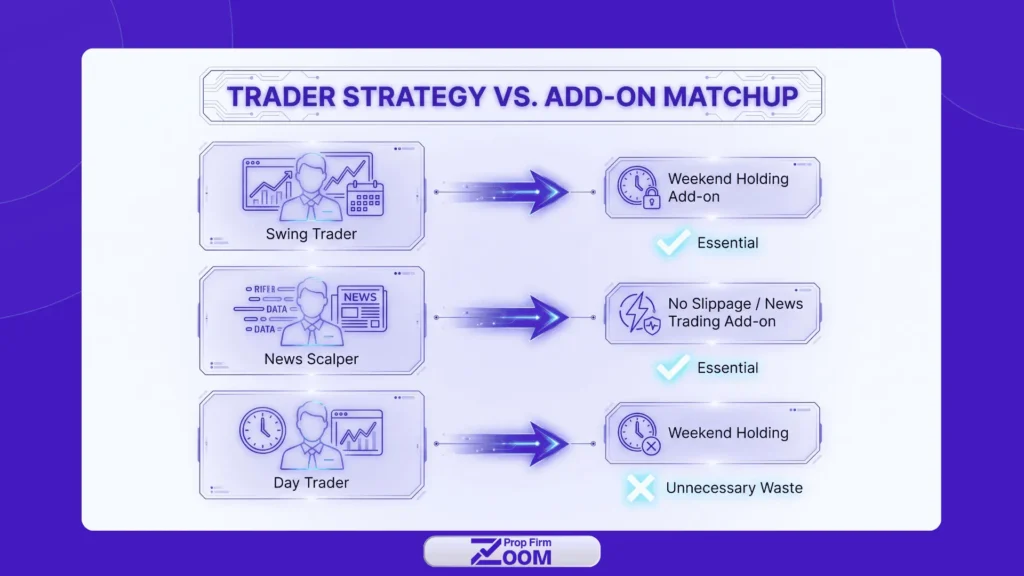
The important point is that add on value is trader specific. Prop Firm Zoom therefore considers the intended use of each add on rather than treating every paid upgrade as equally valuable across all traders.
Are Prop Firm Add Ons a Red Flag?
Prop firm add ons are not automatically a red flag. Many firms offer optional upgrades that provide legitimate benefits, such as wider drawdown, higher profit splits, or additional trading flexibility.
The concern begins when add ons make the advertised account price difficult to interpret, introduce important restrictions, or create a large gap between the headline price and the cost of reasonable trading conditions.

When Add Ons Are Reasonable
Add ons can be reasonable when they are genuinely optional, clearly priced, and provide a measurable benefit.
For example, paying extra for a higher profit split or additional drawdown can make sense when the trader understands the cost and expects to use the upgrade. A firm can also reasonably offer different account configurations so traders can choose the conditions that fit their strategies.
What matters is whether the standard account remains usable on its own and whether the additional cost is proportional to the benefit.
When Add On Pricing Becomes Concerning
Add on pricing becomes more concerning when important trading conditions are effectively hidden behind additional payments.
A low advertised price may look attractive, but if a trader needs several upgrades to obtain reasonable drawdown, payout terms, or trading flexibility, the headline price can become misleading.
Other warning signs include unclear recurring charges, difficult to find pricing, add ons that materially change the account’s economics, or conditions that are not explained until late in the purchase process.
A review should therefore look beyond whether an add on exists and examine how the pricing structure affects the actual cost of trading.
Optional Does Not Always Mean Good Value
Calling an upgrade “optional” does not automatically make it good value.
An add on can be technically optional while still being difficult to avoid for a particular trading strategy. For example, a weekend holding upgrade may be unnecessary for a day trader but practically important for a swing trader.
The review question is therefore not simply:
“Is this add on optional?”
It is:
“Would the typical trader who needs this feature receive enough value to justify the additional cost?”
This distinction is important when comparing firms with different pricing structures. One firm may include a feature in its standard account, while another may charge separately for the same condition.
Why Pricing Transparency Matters
Transparent add on pricing makes it easier for traders to understand what they are actually buying and compare one prop firm with another.
A transparent firm should make it clear:
- What each add on costs
- Whether it is one time or recurring
- Which trading conditions it changes
- Whether it applies during evaluation, funded trading, or both
- Whether it affects payout eligibility
- Whether the add on can be removed or changed
- What the final account cost will be before purchase
For Prop Firm Zoom, transparency is part of the review rather than a minor pricing detail. A firm with several reasonably priced add ons can still receive a strong assessment if its pricing is clear and the upgrades provide meaningful value.
Conversely, a firm with a low headline price may deserve greater scrutiny if traders cannot easily determine the real cost of obtaining the conditions they need.
The presence of add ons is not the red flag. Lack of clarity around their cost, purpose, and impact is.
How Transparent Is a Prop Firm About Add On Pricing?
The number of add ons a prop firm offers does not tell the full story. What matters is how clearly those costs and their effects are communicated to traders.
A prop firm can offer several optional upgrades without creating a problem, as long as traders can understand what each upgrade costs, what it changes, and how much they will pay before completing their purchase.
Are Add On Prices Disclosed Upfront?
Add on prices should be visible before a trader reaches the final stages of checkout.
Traders should not have to search through multiple pages or start the purchase process just to discover the cost of an important upgrade. Clear pricing makes it easier to compare the total cost of different account configurations.
Prop Firm Zoom checks whether add on prices are publicly available and easy to find before purchase.
Are Add Ons Clearly Optional?
A firm should clearly distinguish between the standard account configuration and optional upgrades.
If an add on is genuinely optional, traders should be able to understand what they receive without purchasing it and what additional benefit the upgrade provides.
This distinction also matters when an upgrade is effectively necessary for a particular trading strategy. An add on may be labelled optional while still being highly relevant to traders who need a specific trading condition.
Is the Impact of Each Add On Explained?
Knowing the price of an add on is only part of the information traders need.
A transparent prop firm should explain what changes after purchasing the upgrade. For example, a drawdown add on should specify the additional drawdown provided, while a profit split upgrade should clearly state the new split and when it applies.
Prop Firm Zoom considers both price transparency and condition transparency when reviewing add ons.
Are Recurring Costs Clearly Disclosed?
Recurring costs require additional scrutiny because their impact increases over time.
If an add on costs $5 per month, the trader should be able to identify that it is a recurring charge rather than assuming it is a one time payment. The same applies to subscriptions, ongoing platform fees, or other costs that continue after the initial purchase.
A transparent pricing structure should make the payment frequency clear before checkout.
Is the Final Cost Visible Before Checkout?
The final cost should be reasonably easy to understand before the trader completes the purchase.
This includes the base account price, mandatory fees, selected add ons, and any recurring charges that apply.
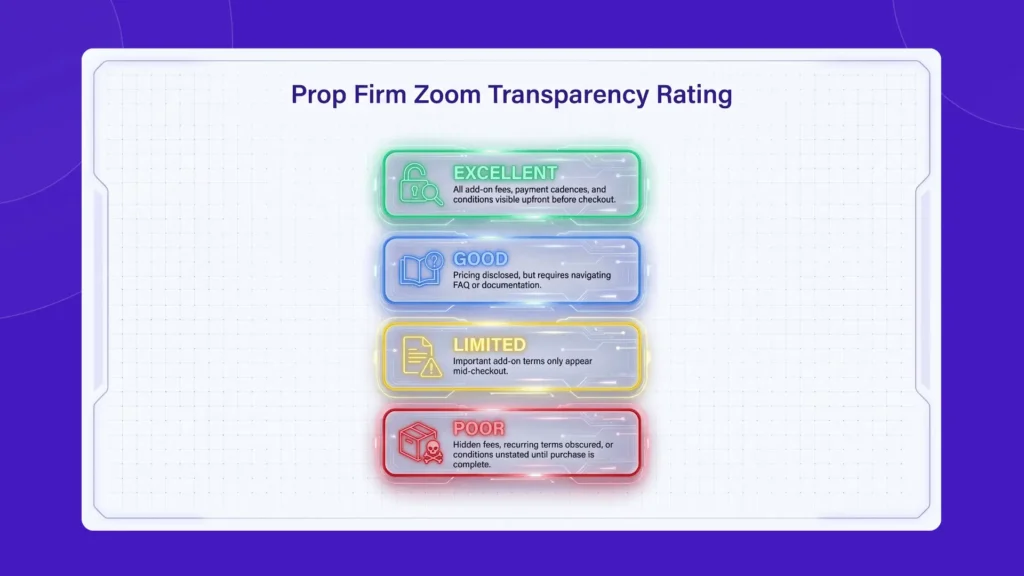
Prop Firm Zoom uses this information to assess an Add On Transparency Rating:
| Rating | What It Means |
| Excellent | Add on prices, conditions, payment frequency, and final costs are clearly disclosed before checkout. |
| Good | Pricing is clear, but some details require additional research or clarification. |
| Limited | Some important pricing or condition details only become clear during the purchase process. |
| Poor | Add on prices, conditions, or their impact are difficult to determine before purchase. |
This rating is separate from the actual cost of the add ons. A firm can have relatively expensive upgrades and still receive a strong transparency rating if those costs are clearly disclosed.
Likewise, a low cost prop firm can receive a weaker transparency rating if traders cannot easily determine what its add ons cost or how they affect the account.
For Prop Firm Zoom, transparency is not about how low the price is. It is about how clearly the trader can understand the price before paying it.
Prop Firm Add On Cost Review Methodology
Prop firm add on costs are not evaluated from the pricing page alone. Prop Firm Zoom reviews them as part of the account’s overall cost structure, starting with the advertised price and then examining what a trader actually pays to obtain different trading conditions.
The goal is to make add on pricing comparable across firms, even when companies package similar features in very different ways.
Base Account Price
The review starts with the standard advertised account price.
Prop Firm Zoom records the account size, evaluation type, and base price before considering any optional upgrades. This establishes the starting point for the cost comparison and prevents optional features from being included in the advertised price by default.
If a firm offers several account configurations, each relevant configuration is reviewed separately rather than using a single headline price.
Mandatory Fees
Next, Prop Firm Zoom identifies costs that traders cannot avoid.

These may include activation fees, mandatory platform charges, verification fees, or other required payments. Mandatory fees are separated from optional add ons because they form part of the actual entry cost.
If a fee is technically described as an upgrade but is required to access a particular stage or feature, the review also considers how that requirement affects the effective account cost.
Available Add Ons
The review then records the add ons available for the specific account being evaluated.
This includes the name of each upgrade, its price, whether it is optional, and the trading condition it changes. Add ons are not treated equally simply because they appear in the same pricing menu.
Prop Firm Zoom looks at the practical purpose of each upgrade and whether it affects evaluation rules, funded trading conditions, payouts, account capacity, or other parts of the trading experience.
Add On Price Range
Rather than focusing on one upgrade, Prop Firm Zoom records the overall range of add on costs.
For example, a firm may offer upgrades ranging from $5 for a minor feature to $30 for additional drawdown. Recording the full range helps show whether add ons represent a small adjustment to the account price or can materially increase the total cost.
Where multiple account sizes are available, prices are assessed in relation to the corresponding account rather than compared only by their dollar amount.
Recurring Add On Costs
One time and recurring charges are evaluated separately.
A $10 one time upgrade has a very different cost profile from a $5 monthly upgrade. Prop Firm Zoom records the payment frequency and considers how recurring costs accumulate over the expected life of the account.
This prevents a small recurring charge from being treated as equivalent to a similarly priced one time upgrade.
What Each Add On Changes
Price alone does not determine the value of an add on.
For every relevant upgrade, Prop Firm Zoom identifies the specific condition that changes. This may include drawdown, profit split, leverage, trading restrictions, payout terms, account allocation, platform access, or holding conditions.
The review then compares the standard condition with the upgraded condition.
For example:
Standard: 5% maximum drawdown
Add On: 6% maximum drawdown
Cost: $15
This makes the benefit measurable rather than simply describing the upgrade as “more flexibility.”
Add On Value
After identifying what changes, Prop Firm Zoom evaluates whether the additional cost is reasonable relative to the benefit.
This is not based on a universal price threshold. A $15 upgrade can have substantial value if it provides a condition that materially affects a trader’s strategy, while a $5 upgrade may have little value if the feature is rarely useful.
The review considers the size of the improvement, its practical relevance, and whether the trader is likely to use it.
Alternative Cost
Prop Firm Zoom also asks a different question: Would another prop firm provide the same benefit without the add on?
This prevents add ons from being evaluated in isolation.
If Firm A charges $15 for an upgrade while Firm B includes the same condition in a $10 higher base price, the comparison should consider the total cost under equivalent conditions.
The alternative is not always another prop firm. Sometimes the better option is simply the standard account without the upgrade if the feature has limited practical value.
Pricing Transparency
Finally, Prop Firm Zoom evaluates how clearly the firm communicates its add on pricing.
The review checks whether prices are disclosed before checkout, whether upgrades are clearly optional, whether their effects are explained, and whether recurring charges are identified.
This information contributes to the Add On Transparency Rating rather than being mixed directly into the dollar cost.
The result is a structured review process:
Base Price → Mandatory Fees → Available Add Ons → Total Cost → What Changes → Value → Alternative Cost → Transparency
This approach allows Prop Firm Zoom to review add on pricing consistently across different prop firms without assuming that fewer add ons or lower prices automatically mean better value.
The Prop Firm Zoom Add On Cost Score
To make add on pricing easier to compare across prop firms, Prop Firm Zoom can evaluate each account using an Add On Cost Score.
The score looks beyond the number of upgrades a firm offers. It considers how transparent the pricing is, what each add on provides, how much it changes the account’s cost and rules, and whether recurring charges create additional risk over time.
The score is designed to evaluate the quality of the add on pricing structure, not simply whether a firm has many or few upgrades.
Add On Cost Transparency
Transparency measures how easily traders can understand the cost and conditions of each upgrade.
A firm scores better when it clearly discloses add on prices, payment frequency, the conditions being changed, and the final cost before checkout.
This criterion also incorporates the Add On Transparency Rating discussed earlier, from Excellent to Poor.
Add On Value
Value measures whether the benefit provided by an add on is reasonable relative to its cost.
An upgrade that provides a meaningful improvement to drawdown, profit split, payout terms, or trading flexibility may offer strong value even if it is not the cheapest option.
The assessment focuses on the practical benefit rather than the price alone.
Optionality
Optionality measures whether traders can reasonably use the standard account without purchasing additional upgrades.
A firm receives a stronger assessment when important trading conditions are included in the standard account and add ons are genuinely optional.
An upgrade can still be labelled optional while being highly relevant to a common trading strategy, so this criterion considers practical necessity rather than the firm’s wording alone.
Cost Impact
Cost impact measures how significantly add ons can increase the effective account price.
For example, a $10 upgrade on a $100 account has a very different impact from a $10 upgrade on a $40 account. Multiple upgrades are also considered together because several small charges can materially change the final cost.
The review therefore considers both individual add on prices and the potential total cost of selecting multiple upgrades.
Rule Impact
Some add ons have a direct effect on the rules governing the account.
An upgrade that changes maximum drawdown, profit split, leverage, holding restrictions, payout conditions, or other material trading rules receives closer scrutiny than an upgrade providing a relatively minor convenience feature.
The greater the effect on the trader’s actual operating conditions, the more important it is to assess whether the additional cost is justified.
Recurring Cost Risk
Recurring charges are evaluated separately because their cost can increase over time.
A one time $15 upgrade is predictable. A $5 monthly charge could become $30 after six months and $60 after a year.
Prop Firm Zoom therefore considers not only the initial price of an add on but also whether ongoing charges could materially increase the account’s long term cost.
Overall Add On Cost Rating
The individual criteria are combined into an overall assessment of the firm’s add on cost structure.
A strong rating does not necessarily mean that every add on is cheap. It means that the pricing structure provides a reasonable combination of transparency, value, optionality, and cost control without creating unnecessary complexity or hidden expenses.
For example, a hypothetical review might produce:
Add On Cost Rating: 8.5/10
This could reflect a firm with clearly disclosed pricing, useful upgrades, mostly genuine optionality, limited recurring costs, and add ons that provide meaningful changes to trading conditions.
The example above is illustrative only. It is not an actual score for any prop firm.
The purpose of the score is to give Prop Firm Zoom a consistent framework for evaluating add on pricing across different firms and account structures.
Rather than asking only “How much does this prop firm account cost?”, the Add On Cost Score asks a broader question:
“How transparent, reasonable, and useful is the additional cost required to access different trading conditions?”
How Prop Firm Zoom Reviews Add On Costs
Prop firm pricing can look simple until different account configurations and optional upgrades are taken into account. Prop Firm Zoom reviews add on costs as part of the full account structure rather than treating them as separate pricing details.
The process is designed to answer a practical question: What would a trader actually pay to get the trading conditions they need?
Looking Beyond the Headline Price
The advertised account price is the starting point, not the final assessment.

A $49 account may remain a $49 account for one trader, while another trader may need additional drawdown, a higher profit split, or a specific trading feature. The review therefore records the base price first and then calculates how selected add ons change the effective cost.
This prevents the lowest number displayed on a pricing page from becoming the entire basis of the review.
Comparing Equivalent Account Conditions
Prop firms often package similar conditions differently. One firm may include a feature in its standard account, while another may offer it as a paid upgrade.
Prop Firm Zoom compares accounts on equivalent conditions whenever possible.
For example, if one firm offers a $50 account with standard drawdown and another offers a $60 account with additional drawdown included, the review does not automatically favor the $50 account. If the trader needs the higher drawdown, the relevant comparison is the total cost of obtaining that condition from each firm.
This makes the comparison more useful than simply ranking accounts by their advertised price.
Separating Optional and Required Costs
Every cost is classified according to whether the trader can reasonably avoid it.
Mandatory fees are included in the effective entry cost. Optional add ons are assessed separately, while upgrades that may be effectively necessary for a particular trading strategy receive additional attention.
This distinction helps prevent two common problems: making an optional upgrade appear mandatory, or treating a practically necessary expense as though it has no effect on the real account cost.
Considering the Trader’s Use Case
An add on does not have the same value for every trader.
A weekend holding upgrade may be important for a swing trader but irrelevant to a day trader. Additional leverage may have limited value for a trader who already operates with conservative position sizes. A higher profit split may be more meaningful for a consistently profitable trader than for someone focused primarily on passing an evaluation.
Prop Firm Zoom therefore considers the purpose of an add on when assessing its value rather than assigning the same weight to every upgrade.
Reviewing Pricing at the Time of Purchase
Prop firm pricing and account conditions can change. Promotions may also temporarily alter the effective cost of an account.
For this reason, reviews should reflect the pricing and conditions available at the time they are checked. Where relevant, temporary discounts, promotional pricing, or changes to add on availability should be distinguished from the firm’s standard pricing.
This also means an add on assessment is not treated as permanently fixed. If the price, conditions, or availability changes materially, the review methodology can be applied again using the updated information.
Prop Firm Zoom does not treat the lowest advertised price as the complete cost of a prop firm account. The review looks at the price required to obtain the relevant trading conditions, how those costs are structured, and whether the resulting account provides reasonable value.
That approach makes add on pricing part of the overall prop firm review rather than a separate pricing footnote.
Prop Firm Add On Cost Comparison
Comparing prop firm add ons becomes more useful when the same pricing structure is applied across multiple firms. Instead of looking only at the advertised account price, traders can compare the base cost, additional upgrades, recurring charges, and transparency of each pricing model.
How to Read an Add On Cost Comparison
An add on cost comparison should show more than the price of individual upgrades.
The first step is to identify the base account price and then determine how much a trader would pay for the add ons relevant to their trading needs. Recurring charges should be separated from one time costs because they can continue increasing the total cost over time.
Transparency is also important. A firm with several add ons may still have a clear and reasonable pricing structure if every cost and condition is disclosed upfront.
The following is a hypothetical example for illustrating the methodology only:
| Firm | Base Price | Add On Cost | Recurring Cost | Transparency |
| Firm A | $49 | $35 | No | High |
| Firm B | $59 | $72 | Yes | Medium |
| Firm C | $79 | $10 | No | High |
These figures are not actual prop firm pricing and should not be interpreted as a ranking.
The table simply demonstrates how Prop Firm Zoom can organize pricing information before assessing the overall cost and value of an account.
Why the Lowest Base Price Is Not Always the Cheapest
A lower base price does not necessarily mean a lower total cost.
If Firm A costs $49 but a trader needs $35 in upgrades, the relevant cost for that trader is $84 rather than $49. A firm with a higher starting price may become cheaper once equivalent trading conditions are included.
Recurring charges can make the difference even larger. An add on that costs a small amount each month may eventually cost more than a higher one time upgrade.
This is why Prop Firm Zoom separates the headline price from the effective cost when reviewing add on structures.
Comparing Prop Firms on Equivalent Terms
The most useful comparison is based on equivalent trading conditions.
If one firm includes a feature that another charges for, the paid upgrade should be added to the second firm’s cost before comparing the accounts.
For example:
Firm A: $49 + $20 required upgrade = $69
Firm B: $65 with the equivalent feature included = $65
Firm B has the higher advertised price but the lower effective cost under those conditions.
The comparison can also change depending on the trader’s needs. A trader who does not need the upgrade may reasonably prefer Firm A at its $49 base price, while a trader who requires that feature may find Firm B more economical.
The purpose of an add on cost comparison is therefore not to identify a universal cheapest firm. It is to show how the total cost changes when accounts are compared on equivalent terms and relevant trading conditions.
Questions to Ask Before Paying for a Prop Firm Add On
Before paying for a prop firm add on, traders should understand exactly what they are buying and how the upgrade affects the account. A few practical questions can help determine whether the additional cost is justified.
Is the Add On Actually Optional?
Check whether the account remains fully usable without the upgrade. An add on may be labelled optional but still be important for certain trading strategies.
What Exactly Does the Add On Change?
Identify the specific condition being upgraded. Does it increase drawdown, change the profit split, remove a trading restriction, increase leverage, or improve payout terms?
If the benefit is unclear, the price is difficult to evaluate.
Does It Apply to the Funded Stage?
Some upgrades may apply only to the evaluation and not to the funded account.
Check exactly when the benefit becomes active and whether the same condition continues after passing the evaluation.
Is the Cost One Time or Recurring?
Confirm whether you pay for the add on once or continue paying for it over time.
A recurring fee can make a relatively small upgrade significantly more expensive over the life of the account.
Is the Add On Refundable?
Check the firm’s refund policy before purchasing an upgrade.
If the account or evaluation is refundable under certain conditions, determine whether the add on is included in that policy or treated separately.
Does It Affect Payout Eligibility?
Some upgrades may change payout conditions, profit splits, thresholds, or other requirements.
Make sure the benefit applies to the payout stage you care about rather than only improving the evaluation experience.
Can Another Prop Firm Offer the Same Feature?
Compare the add on with competing accounts that include the same feature as standard.
If another firm offers equivalent conditions without an additional charge, the add on may not provide the best overall value.
Does the Add On Justify Its Cost?
Finally, compare the additional cost with the practical benefit.
If the upgrade meaningfully improves the trading conditions you need, it may be worth paying for. If the benefit is unlikely to affect your trading, keeping the standard account—or choosing another prop firm—may make more sense.
FAQ About Prop Firm Add On Costs
What Are Prop Firm Add Ons?
Prop firm add ons are optional upgrades that change or expand certain features or trading conditions of an account. Common examples include additional drawdown, higher profit splits, larger allocations, higher leverage, or expanded trading flexibility.
Are Prop Firm Add Ons Mandatory?
Not always. Most add ons are optional, but some fees or upgrades may be required to access particular account features or stages. Traders should check whether the standard account remains fully usable without the upgrade.
What Is the Most Common Prop Firm Add On?
Additional drawdown is one of the most common types of prop firm add ons. Other common upgrades include higher profit splits, account resets, larger allocations, higher leverage, and additional trading flexibility.
Do Prop Firm Add Ons Increase the Real Cost?
Yes. Any paid add on increases the amount a trader pays to access the selected account conditions. The effective cost should therefore be calculated using the base price, mandatory fees, selected add ons, and any recurring charges.
Are Prop Firm Add Ons Worth Paying For?
An add on can be worth paying for when it provides a meaningful benefit that the trader actually needs. The cost should also be compared with alternative prop firms that may include the same feature in their standard account.
Can an Add On Change Trading Rules?
Yes. Some add ons directly change trading conditions, such as maximum drawdown, profit split, leverage, holding restrictions, or payout terms. Traders should always check exactly which rules are affected before purchasing an upgrade.
Do Add Ons Apply to Funded Accounts?
It depends on the prop firm and the specific add on. Some upgrades may apply only during the evaluation, while others continue into the funded stage. The terms should clearly state when the benefit becomes active and how long it remains available.
How Should Traders Compare Prop Firm Add On Costs?
Compare the total cost of equivalent trading conditions rather than the advertised account price alone. Consider the base price, mandatory fees, add on costs, recurring charges, the benefit provided, and whether another prop firm includes the same feature at no additional cost.
Final Thoughts on Prop Firm Add On Costs
Prop firm add ons can make account pricing more complicated than the headline price suggests. A fair comparison therefore needs to look at the complete cost and the trading conditions attached to it.
A simple framework is:
Base Price → Add Ons → Total Cost → Trading Conditions → Value → Transparency

Start with the advertised account price, identify any mandatory fees and relevant add ons, and calculate the total cost under the conditions the trader actually needs. Then compare that cost with the trading rules, the practical value of each upgrade, and alternative accounts from other prop firms.
The goal is not to find a prop firm with the fewest add ons. It is to understand what you are paying for and whether the final cost matches the trading conditions you need.
For Prop Firm Zoom, this is what makes add on pricing part of a proper prop firm review rather than just another number on a pricing page.